Nick Petrangelo’s 26-Day Training Plan Now Available On-Demand + 1 Month Pro Free. Learn more.
Hamburger
ICM strategy in tournament poker — GTO LAB coaching guide covering all tournament stages

ICM Strategy in Tournament Poker: The Complete Guide

Two columns. One game.

At every stage of a tournament, there is a theoretically correct strategy — and a more profitable one. This guide shows you both.

GTO ICM strategy

  • What risk premiums actually look like at each stage
  • Why the solver tightens at 50% paid — and why that’s mostly wrong
  • How stack vs field average drives bubble pressure, not raw BBs
  • What distribution and arrangement mean near the final table

Exploitative ICM strategy

  • Where the best players deliberately ignore the model — and why
  • How to exploit the players who follow solver outputs too literally
  • When to inflate variance, attack limpers, and own the post-bubble window
  • What human judgement does that no solver can replicate

There are two ways to play tournament poker. One way is to follow the solver — understand the theory, apply the right risk premiums at the right stages, and let the model guide you through each decision. The other way is to read the table, identify the mistakes your opponents are making right now, and deviate from theory to extract more than the solver thinks is possible.

The best tournament players do both. Nick Petrangelo and Daniel Dvoress built Tournament Savagery around the tension between these two modes — what the solver says, and where human judgement outperforms it. Jonathan Jaffe has built his entire career around the second column. Think of it this way: the GTO ICM column is how the game is played at Triton — deep-stacked, elite fields where theoretical precision matters because opponents punish every deviation. The exploitative ICM column is how the game is played at the WSOP Main Event — large recreational fields where reading the table beats following the solver. Most tournaments you play sit somewhere between both. Leon Sturm and Leonard Maue live in the space between both.

Every Game plan box in this guide is built around that same duality — GTO ICM strategy on the left, Exploitative ICM strategy on the right. The GTO ICM column tells you what the model prescribes. The Exploitative ICM column tells you when to ignore it, and why. ICM strategy is not one thing. It’s a different calculation at every stage of the tournament — and the adjustments at stage two are almost the opposite of what you need at stage four. This is the map. If you want structured practice applying it, the 26-Day Training Plan is built around exactly this arc.

One note on scope: this guide covers standard payout structures. Progressive knockout tournaments follow different ICM logic — bounties create their own pressure that interacts with standard ICM in ways that require a separate framework. Leonard Maue covers PKO ICM in depth in a dedicated guide coming soon.


What ICM strategy actually means

The Independent Chip Model converts your stack into a dollar value based on the prize pool and your probability of finishing in each paid position. That value is not linear. Doubling your chips does not double your equity. Losing everything eliminates it entirely.

ICM strategy is the practical consequence of this non-linearity. Because losing chips costs more than winning the same number gains, you adjust away from pure chip EV whenever the ICM cost of losing a confrontation is high relative to the gain. That adjustment is called a risk premium. Risk premiums vary by stack size, proximity to pay jumps, and tournament stage — they are not a fixed dial you turn up as the tournament progresses. The full ICM vs chip EV breakdown is covered in the dedicated guide. What follows here is how those risk premiums change across the arc of a tournament — and what that means for your Game plan at each stage.


Stage 1: Early tournament — play close to chip EV

Early in a tournament — registration still open, bubble hundreds of hands away — your primary goal is chip accumulation. ICM pressure is essentially zero. Playing below chip EV doesn’t protect anything at this stage: it just makes you a worse tournament player.

The most important early-stage skill has nothing to do with ICM. It’s pre-flop sizing, post-flop range construction, and identifying the specific leaks in your player pool. The day-one soft field is where your ROI is generated — not from survival, but from extracting value from recreational players and weak regulars before the field tightens up.

“The first few levels are so important. If you can put together that stack — imagine he is a very whaley player and you happen to be 180K deep with him. This could be an excellent spot to accumulate chips.”

Nick Petrangelo · Deep Stacked in Soft Fields | GTO LAB

Early tournament ICM strategy — Jonathan Jaffe and Brian Kim | GTO LAB
Jonathan Jaffe & Brian KimDeep Stacked in Soft Fields | GTO LAB

Early tournament ICM strategy

Game plan — Early stages

Accumulate. ICM is not in play yet — your ROI is made here.

Nick Petrangelo

GTO ICM strategy  ·  Nick Petrangelo

  • Open 2x–2.2x deep, shift to min-raise as stacks shorten
  • UTG is not a LJ range — EP discipline matters
  • Defend BB wide — suited connectors have clear chip EV
  • Balance 3-bets: value needs bluffs with playability behind it
  • C-bet sizing calibrated to SPR, not emotion
Brian Kim

Exploitative ICM strategy  ·  Brian Kim

  • Soft field day 1: play no balance — passive with mediums, fast-play only the nuts
  • Found the whale? Inflate variance against them. This is your highest EV spot all tournament
  • Whale on your right and still deep? Play pots with them, not around them
  • Against nits: widen flats, punish 3-bet-or-fold tendencies relentlessly
  • Skip fancy check-raise bluffs vs weak players — simple c-bets are already printing

Stage 2: Mid-tournament — ICM builds, but slowly

ICM pressure builds gradually as the bubble approaches — not as a switch that flips. The most expensive consequence: players apply solver adjustments too early and arrive at the actual bubble short of chips.

In tournaments where 50% of the remaining field gets paid, solvers show meaningfully tighter strategies than chip EV — BB defense drops from ~60% to ~37%, suited connectors vanish from flatting ranges. Players study these outputs and apply them directly. Most are making a mistake.

The solver forecasts finishing positions from current stacks. It cannot account for the hundreds of hands still to play, your skill edge, or the fact that the real money is at the final table. These adjustments only become reliable in the final 15–20% of the remaining field before the bubble.

“Don’t just take the sims at face value, because there are big time real life applications where you want to deviate. Accumulating chips is really important — because all the money’s up top.”

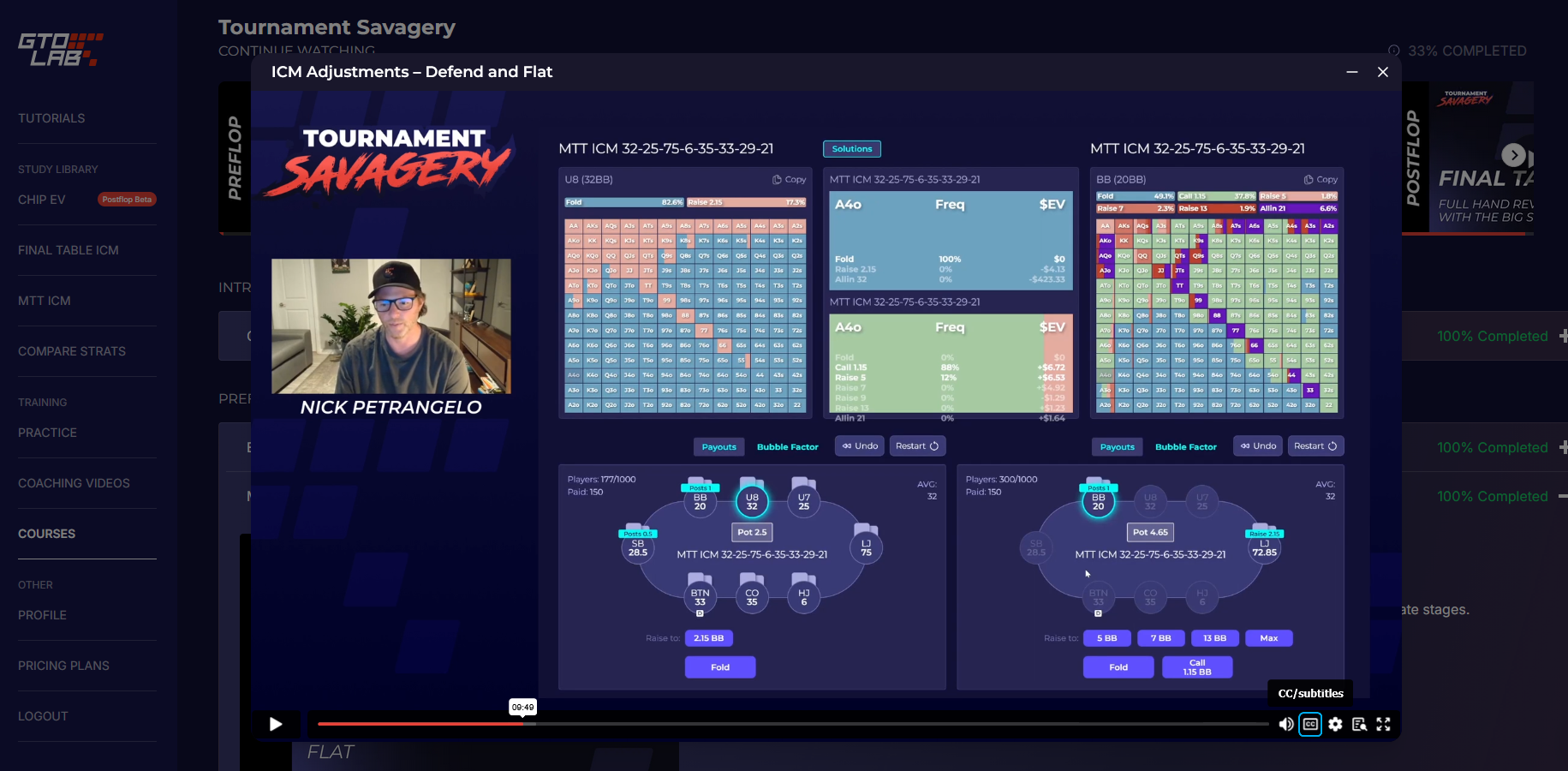
Nick Petrangelo · Tournament Savagery — Changing ICM Conditions | GTO LAB

Mid-tournament ICM strategy — Jonathan Jaffe | GTO LAB
Jonathan JaffeAll Things Exploits | GTO LAB

Mid-tournament ICM strategy

Game plan — Mid-tournament (50% of entries paid)

Understand why the solver is wrong before you follow it.

Daniel Dvoress

GTO ICM strategy  ·  Daniel Dvoress

  • BB defense drops 60% → 37% — gappers and connectors disappear
  • Opener ranges go high-card heavy
  • 3-bet frequency up, flatting vs opens down
  • Only becomes reliable in final 15–20% of remaining field before bubble
Jonathan Jaffe

Exploitative ICM strategy  ·  Jonathan Jaffe

  • “I like to go off script” — at 50% paid, going off script is the correct play
  • Spot who’s following the solver: predictable ranges, bluffier c-bets, over-folding
  • They’re defending their big blind too tight — flat their opens and outplay them post-flop
  • Recreational with 23bb flatting the BTN? They’re calling off anything. Jam wide over them

Stage 3: The bubble — ICM peaks

On the bubble, ICM pressure reaches its peak. Risk premiums are highest. Survival has maximum value. And player behaviour becomes highly predictable — which is exactly where informed players have an edge over those who just feel tight without understanding the numbers.

The key principle: risk premiums depend on stack vs field average, not raw big blinds. A 6bb stack into a 40bb average has a higher risk premium than a 10bb stack into a 22bb average — because doubling in the first case barely moves your tournament equity. The full framework is in the bubble ICM guide.

“Don’t just think of some arbitrary number of BB as a short stack. It relates to the tournament average — not just how many BB you have.”

Daniel Dvoress · Tournament Savagery — Bubble Factors | GTO LAB

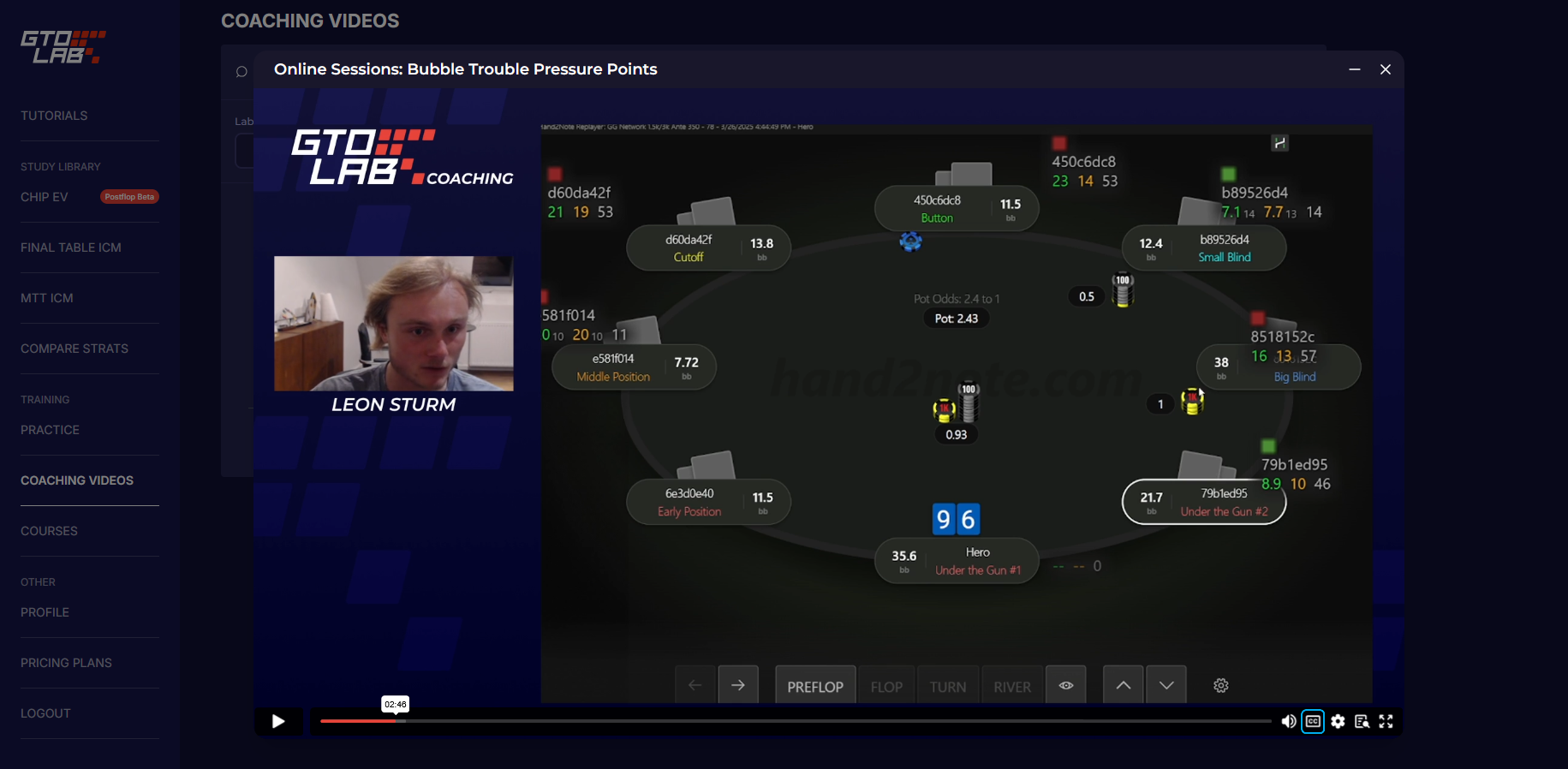
Bubble ICM strategy — Leon Sturm | GTO LAB
Leon SturmOnline Sessions: Bubble Trouble Pressure Points | GTO LAB

Bubble ICM strategy

Game plan — The bubble

Stack vs field average — not big blinds. Read the table, not the chart.

Daniel Dvoress

GTO ICM strategy  ·  Daniel Dvoress

  • Risk premiums peak at 10–20% — but depend on stack vs field average
  • 6bb into 40bb avg = higher premium than 10bb into 22bb avg
  • Chip lead still has real risk premium vs covering stacks
  • 3-bet sizes up across the board — everyone wants to win without showdown
Leon Sturm

Exploitative ICM strategy  ·  Leon Sturm

  • Medium stacks are massively over-folding — open them from late position relentlessly
  • Taking chip lead changes how opponents VPIP against you on the actual bubble hands
  • Awkward sizing (3.5x open with 7bb behind) = they want to fold. Re-jam and collect
  • Aggressive unknown running hot? “2–3 orbits to get an idea” — isolate early, own that EV

Stage 4: The bubble bursts — the biggest ICM shift in the tournament

Of all the ICM transitions in a tournament, the bubble bursting is the most dramatic — and the most abrupt. Every other transition is gradual. This one is not. One moment risk premiums are at their peak. The next hand, they almost entirely disappear.

“The bubble bursting is the biggest shift in the ICM of the tournament that you will encounter. You go from really high risk premiums to something quite comforting. Generally speaking, once the bubble has burst in large field tournaments, you’ll see risk premiums that are roughly zero to low single digits.”

Daniel Dvoress · Tournament Savagery — Post Bubble | GTO LAB

Players who don’t internalise this keep playing bubble-tight poker for one, two, or three levels after the money is made, bleeding EV in every hand. The players who adjust immediately capture all of it. This is also where future game equity starts to matter more — both in terms of stack arrangement and skill edge preservation.

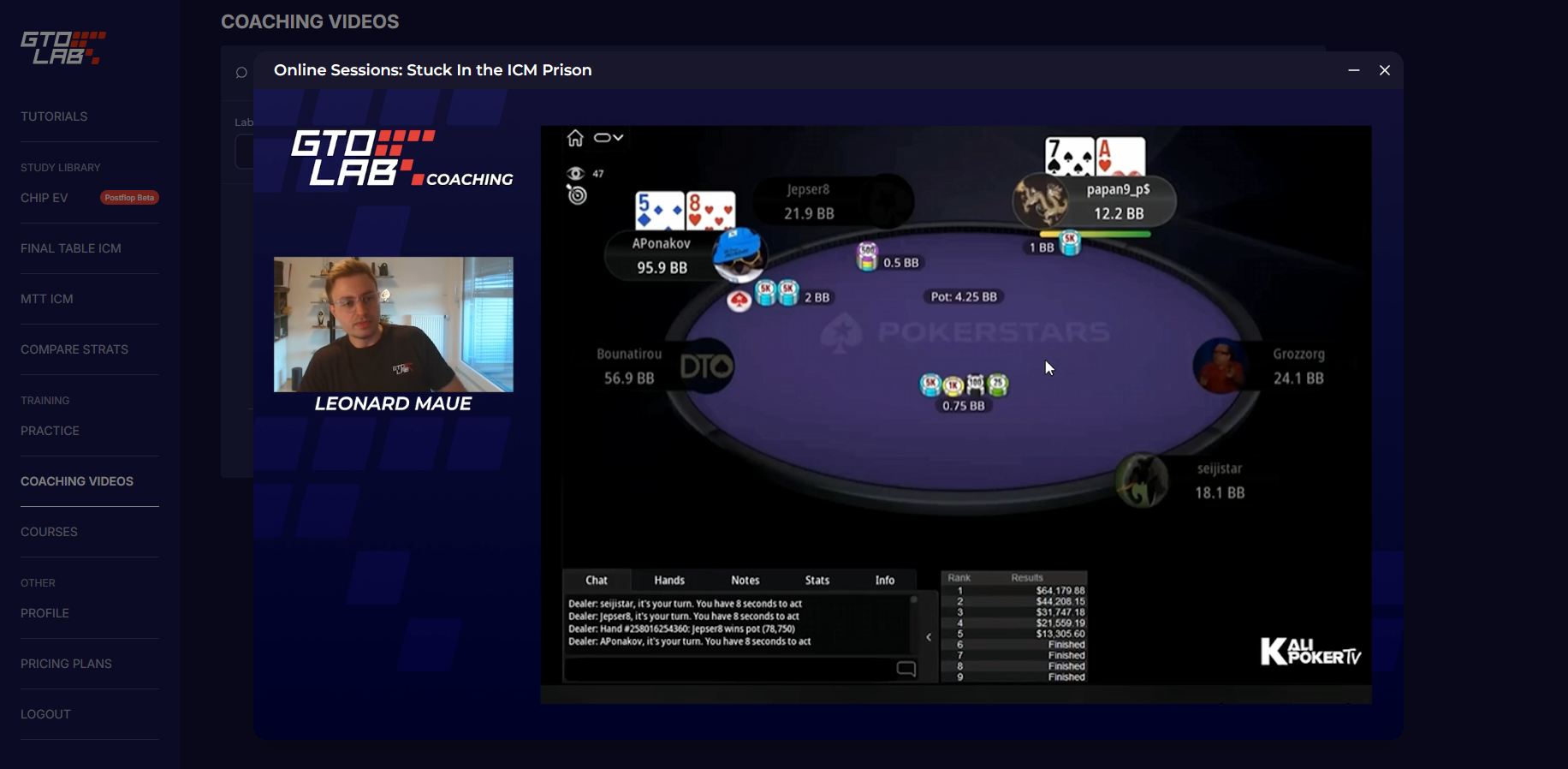
Post-bubble ICM strategy — Leonard Maue | GTO LAB
Leonard MaueOnline Sessions: Stuck in the ICM Prison | GTO LAB

Post-bubble ICM strategy

Game plan — Post-bubble

The biggest ICM shift just happened. Most players haven’t processed it — that’s your window.

Daniel Dvoress

GTO ICM strategy  ·  Daniel Dvoress

  • Risk premiums collapse from peak → below 5% in one hand
  • Open ranges widen immediately back toward chip EV
  • Defend BB again — suited connectors and gappers are back
  • Short stack shove thresholds return to near chip EV

Exploitative ICM strategy  ·  Leonard Maue

  • Players still in “ICM prison” are over-folding — those orbits are free chips
  • Chip leader has near-polar range (any two): SB calling range is razor thin, BB is actually wider than opponents think
  • Sizing tells sharpen post-bubble: small c-bet on a wet board = protection, not weakness
  • Flat payout? Know what chips actually get you — doubling 15bb → 30bb may not shift your finishing distribution

Stage 5: Near the final table — distribution and arrangement

As you approach the final table, ICM pressure rebuilds — but it does so differently from the bubble approach. Two factors now dominate strategy more than anything else: stack distribution and stack arrangement.

Distribution means how varied the stacks are. In a flat distribution, pressure is moderate and two-way. With extreme short stacks and a runaway chip leader, you’re a medium stack playing not to freeroll the shorts into pay jumps above you. Arrangement means seat positions — a covering stack directly to your left is a fundamentally different problem than that same stack to your right. The same 13bb plays completely differently depending on whether the field average is 40bb or 22bb.

“The two main driving factors that are going to determine your range — how loose you can be and what size to use — are the distribution of the other stacks and the arrangement of the other stacks.”

Daniel Dvoress · Tournament Savagery — Near Final Table | GTO LAB

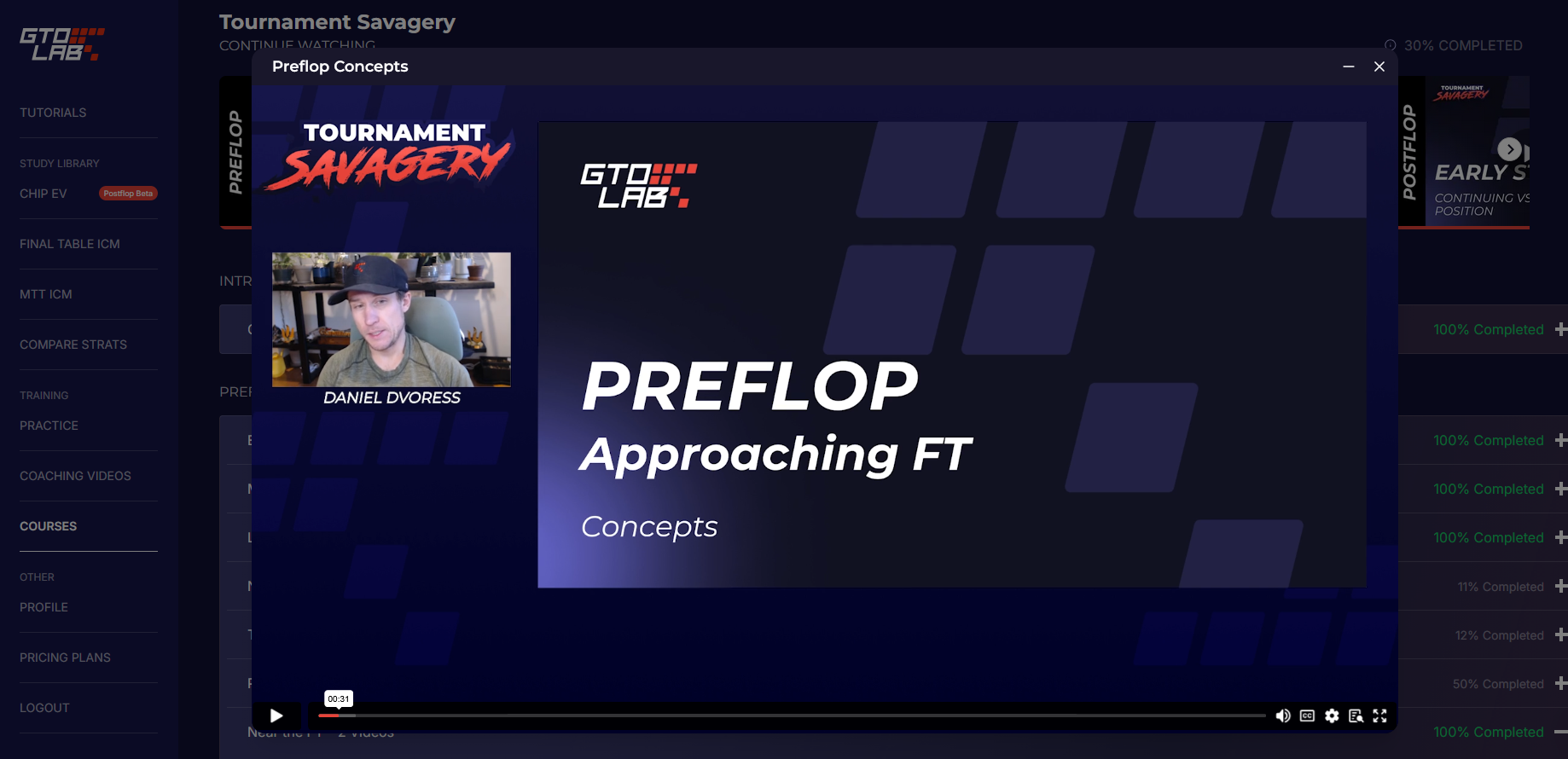
Near final table ICM strategy — Nick Petrangelo and Jonathan Jaffe | GTO LAB
Nick Petrangelo & Jonathan JaffeTournament Savagery: Near Final Table | GTO LAB

Near final table ICM strategy

Game plan — Near the final table

Read the landscape before you read your hand.

Nick Petrangelo

GTO ICM strategy  ·  Nick Petrangelo

  • Flat distribution: moderate two-way pressure — opens and 3-bets are roughly normal
  • Short stacks + chip leader: medium stack plays tight, high-card-oriented
  • 13bb into 40bb avg ≠ 13bb into 22bb avg — completely different shove thresholds
  • Covering stack behind: tighter, high-card range. Short stacks behind: normal shape returns
Jonathan Jaffe

Exploitative ICM strategy  ·  Jonathan Jaffe

  • Less experienced players freeze at FTs — “don’t want to do something silly.” Open those spots
  • Expand with high cards + blockers vs weaker players, not low connectors — they still find hands to jam
  • Empty limper? Attack with small raises every time. You print if their range is wide and weak
  • Two strong players at your table play cooperatively — know when you’re the soft money for both

Stage 6: The final table — structure, seat quality, and postflop ICM

At the final table, ICM pressure is both high and highly variable. Before you look at a single hand, there are structural factors that determine your entire posture: payout structure, ante format, stack vs average, and who covers you from which seat.

The full final table ICM guide covers payout structures, ante formats, and runaway chip lead dynamics in depth. Two concepts connect back to the broader ICM arc. First: the runaway chip leader. When someone has 2–3x the average shorthanded, their risk premium drops below 1% — they are, as close as tournament poker allows, playing for chips. Second: postflop ICM. Under ICM pressure, chips you risk are worth more than chips you stand to gain — which changes how you construct bluffs, size bets OOP, and whether large confrontations are profitable even with strong made hands. The common ICM mistakes guide covers the most expensive postflop errors in detail.

“Me and Jon Jaffe, we were just playing like total dickheads the whole time. No one ever considered adjusting until there were like 5 guys left until the money. There are a lot of limitations — and a lot of good things about not considering ICM too early.”

Nick Petrangelo · Tournament Savagery — Changing ICM Conditions | GTO LAB

Final table ICM strategy — Nick Petrangelo | GTO LAB
Nick PetrangeloTournament Savagery: Final Table | GTO LAB

Final table ICM strategy

Game plan — Final table

Macro frame first — payout, ante, seat quality, geometry — then look at your cards.

Nick Petrangelo

GTO ICM strategy  ·  Nick Petrangelo

  • Flat structure (GGMillion$): laddering is valuable, survival matters more per jump
  • Top-heavy (Monster Stack): chip accumulation critical — laddering at the cost of cEV destroys value
  • Live BB ante shorthanded: shove ranges widen significantly vs online every-player ante
  • Runaway chip leader (2–3x avg): risk premium drops below 1% — they’re playing for chips
Leon Sturm

Exploitative ICM strategy  ·  Leon Sturm

  • Chip leader on your left? “Most people don’t abuse it the way they should” — don’t freeze up
  • 11% 3-bet frequency with any shown bluffs: “once someone can find a bluff, they overdo it” — call them down
  • AQs at the FT: often the right call when ranges are polar and you block their AJ combos. The fold is lazy
  • Sizing tells peak at the final table — small c-bet where bigger is expected means protection. Use it

The ICM pressure curve

Every ICM transition is gradual except one. The post-bubble reset is abrupt — and the players who adjust immediately capture significant EV from everyone who doesn’t.

The table below summarises how ICM strategy adjustments change at each tournament stage — and why the post-bubble reset is the only abrupt transition in the entire arc.

Stage Risk premium (avg stacks) ICM adjustment
Early / 50%+ field remaining ~0–2% Play close to chip EV — accumulate
85% of field paid ~5–10% Moderate adjustments — real but limited
Stone bubble ~10–20% (stack dependent) Major adjustments — ICM at maximum
Just in the money (large field) ~0–5% Biggest single shift — reset immediately
Near final table ~5–15% (distribution dependent) Rebuilds — driven by stack arrangement
Final table ~10–20%+ (structure dependent) High and variable — structure-specific

ICM strategy: frequently asked questions

What is ICM strategy in poker?

ICM strategy refers to the adjustments tournament players make to account for the non-linear value of chips in prize pool equity. Because doubling your chips doesn’t double your equity and losing all your chips eliminates you from the prize pool, you need a larger equity advantage to justify risking your stack than chip EV math would suggest. ICM strategy is the set of adjustments — tighter ranges, smaller bet sizes, more cautious confrontations — that reflect this reality at each stage of the tournament.

When does ICM pressure start to matter in a tournament?

Meaningfully: when you’re within roughly 15–20% of the remaining field from a real pay jump. In large-field tournaments this means the final stretch before the money bubble — not the halfway point of the field. At 50% of entries paid, risk premiums for average stacks are usually under 4% — and adjusting your strategy significantly at that point is one of the most common and costly errors in tournament poker.

What is the difference between ICM and chip EV?

Chip EV is the expected value measured purely in chips, assuming each chip has equal value. ICM adjusts for the reality that chips have diminishing returns — the more you have, the less each additional chip is worth in prize pool equity. Under ICM, losing chips costs more than winning the same number gains. The ICM vs chip EV guide covers this in full detail.

What happens to ICM pressure when the bubble bursts?

It collapses — abruptly, unlike every other ICM transition in the tournament. In large-field events, risk premiums drop from their peak of 10–20% to below 5% almost immediately. This is the single biggest ICM shift you will experience in any tournament. Players who open up their ranges immediately and exploit those still playing bubble poker in the first few hands after the money capture significant EV. Adjust immediately, not gradually.

What are the most common ICM strategy mistakes?

The six most costly — applying ICM adjustments too early, misreading short stack risk premiums by thinking in raw big blinds, big stacks gambling and medium stacks freezing simultaneously on the bubble, drawing false conclusions from solver outputs, OOP postflop sizing too large under ICM pressure, and treating ICM bluffs as break-even — are covered in the common ICM mistakes guide.


ICM strategy: key takeaways

ICM pressure follows a curve — builds to the bubble, collapses when it bursts, rebuilds to the final table
The bubble bursting is the single biggest shift in any tournament — adjust immediately
At 50% paid, solver ICM adjustments are largely misleading — play chip EV, build the stack you need for the real bubble
Short stack pressure is about stack vs field average — not raw big blinds
Near the final table, distribution and arrangement matter more than raw risk premiums
Postflop under ICM: size down from chip EV — geometric sizing leaks equity even with strong hands

Ready to apply this?

The Tournament Savagery course by Nick Petrangelo and Daniel Dvoress covers every stage of this guide in full depth — with solver work, hand histories, and the ICM framework behind every decision. The 26-Day Training Plan gives you a structured path to internalise all of it.

ICM Strategy — Complete Guide

→ What Is ICM in Poker?
→ ICM vs Chip EV
→ ICM on the Bubble
→ Final Table ICM
→ Common ICM Mistakes
→ Short Stack ICM (coming soon)
→ Big Stack ICM (coming soon)
→ ICM in PKOs (coming soon)
→ Postflop ICM (coming soon)
→ How to Study ICM (coming soon)

Train with GTO LAB: Tournament Savagery  ·  26-Day Training Plan

This website uses cookies to enhance your browsing experience, analyze site traffic, and serve better user experiences. By continuing to use this site, you consent to our use of cookies. Learn more in our cookie policy.