


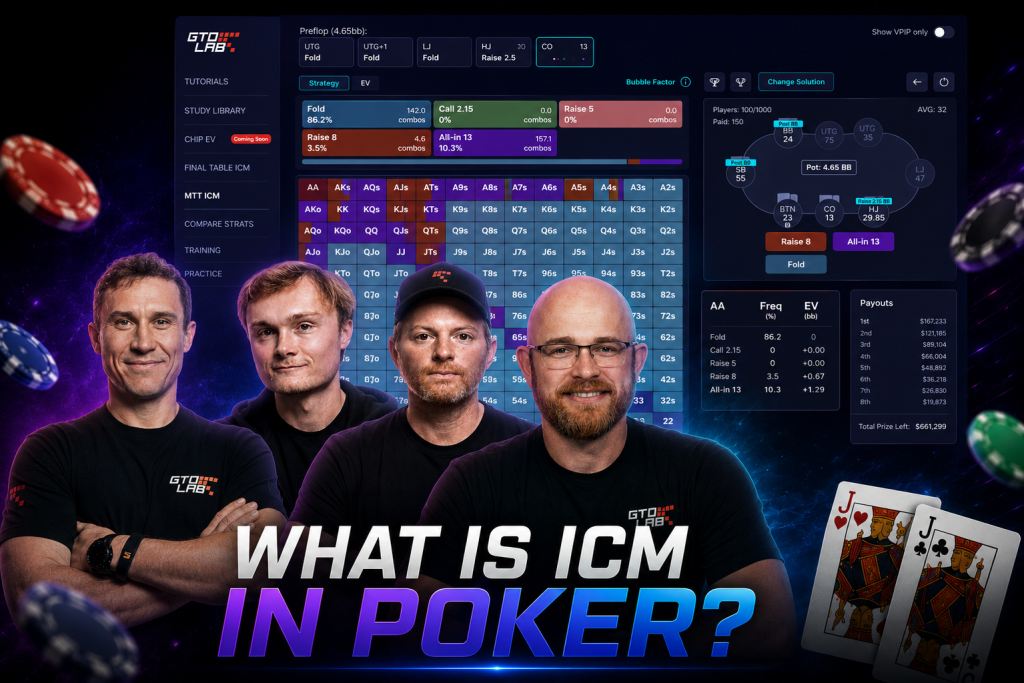
What you’ll learn
- Why chips and money work differently in tournaments
- How ICM calculates your real dollar equity at any stage
- What the risk premium (bubble factor) actually means
- How ICM changes calling ranges and aggressive plays simultaneously
- When ICM matters, and when to stick to chip EV.
- How to build ICM instincts that hold up under table pressure
| Concept | In plain terms | Why it matters |
|---|---|---|
| ICM equity | Your stack converted to expected dollar value | Determines actual tournament value, not just chips |
| Risk premium | Extra equity needed above chip EV breakeven | Tightens calling ranges near pay jumps |
| Bubble factor | EV lost ÷ EV gained in an all-in spot | Always >1 losing chips always hurts more |
| ICM pressure | How much ICM constrains your strategy | Highest near bubble & final table pay jumps |
| Chip EV | Every chip has equal, linear value | The right model deep in field, wrong at bubble |
What is ICM in poker? The Independent Chip Model (ICM) is the most important concept in tournament poker that most players never fully understand. You can grind thousands of hours, study preflop charts until they’re automatic, and build a solid postflop game, and still consistently haemorrhage money at final tables and bubbles because you’re applying the wrong mathematical framework to every decision.
This guide draws on GTO LAB’s full coaching roster: Nick Petrangelo‘s mechanical ICM framework, Dylan Linde‘s final table application, Ben Heath‘s inequal stack work, Leon Sturm‘s postflop ICM framework, and Daniel Dvoress‘s real-time decision-making.
The core problem: chips ≠ money in tournaments
In a cash game, the relationship between chips and money is trivial: one $100 chip is worth exactly $100. Winning 1,000 chips gains you exactly as much as losing 1,000 chips costs you.
Tournaments break this relationship completely. In a tournament the prize pool is fixed, winning every chip in play earns you first place, not every dollar. This creates a nolinear relationship between your chip count and your real dollar equity, a key reason whICM and chip EV diverge so dramatically that shifts with every hand played and every player who busts.
The most important asymmetry in tournament poker
A chip lost is worth more than a chip gained. Near the bubble, losing your stack can cost 10–20× more in dollar terms than winning the same number of chips would gain. This asymmetry, quantified by ICM, gov every meaningful decision from the bubble to the final table.
How ICM calculates your dollar equity — and why it matters
ICM takes two inputs: every remaining player’s chip count, and the payout structure. From these, it estimates the probability of each player finishing in every possible position, then sums the prize from each outcome.
The core assumption: your probability of finishing first is proportional to your chip count. If you have 30% of the chips, you have a 30% chance of finishing first. Given you finish first, the remaining players’ 2nd-place probabilities are recalculated proportionally. The model iterates through every possible finishing order and weights each by its probability.
“What I really want to do is take you through the process I use to study and analyse situations like this. this. The first thing you want to do is make a spreadsheet of the tournament state, listing all the payoutsnd filling in representative stack sizes. This gives you a nice framework to assess your stack value and the potential stack values of doubling or busting.”
Daniel Dvoress · Big Field ICM: Valuing Your Stack | GTO LAB

Daniel Dvoress on valuing your stack in big field tournaments, Big Field ICM | GTO LAB
The key simplification, and main limitation, of standard ICM: it assumes all players are equally skilled. A more sophisticated model called Future Game Simulations (FGS) addskill component. But standard ICM is the foundation every tournament player needs to master first.
A concrete example: chip EV vs ICM
Three players remain. Payouts: 1st = $10,000, 2nd = $6,000, 3rd = $4,000.
| Player | Chips | Chip % | Chip EV equity | ICM equity |
|---|---|---|---|---|
| Player A | 60,000 | 60% | $8,200 | |
| Player B | 30,000 | 30% | $6,000 | $5,500 |
| Player C | 10,000 | 10% | $2,000 | $4,300 |
Payout: 1st $10,000 · 2nd $6,000 · 3rd $4,000. 100,000 chips total in play.
Player A’s chip EV equity of $12,000 is impossible first place only pays $10,000. ICM gives the correct answer: $8,200. Player C has only 10% of chips but their ICM equity ($4,300) vastly exceeds chip EV ($2,000) because they’re guaranteed at minimum $4,000 for finishing 3rd.
This divergence determines whether Player A should call a shove from Player C — something chip EV alone can’t tell you.hip EV says is a clear call but ICM may flag as a close fold. SeeICM vs Chip EV Explained
The risk premium: ICM in real decisions
The practical mechanism through which ICM affects your decisions is the risk premium also called the bubble factor. This multiplier tells you how much better a call needs to be in chip EV terms to be correct in ICM terms.
Chip EV ≈ ICM
Breakeven calls become folds
Maximum ICM pressure
“There’s a core ICM principle that winning X amount of chips gets you less real dollars in terms of tournament EV compared to how many dollars of EV you would lose if you were to lose that same amount of chips. Losing some amount of chips is always more costly than the benefit of winning that amount of chips. What the bubble factor does is it considers a pair of players, puts them all-in against each other, and looks at how much iturts their EV to lose versus how much EV they gain when they win. And because of the core ICM principle, it will generally be one point something.”
Nick Petrangelo·Tournament Savagery: Risk Premiums and Bubble Factors | GTO LAB
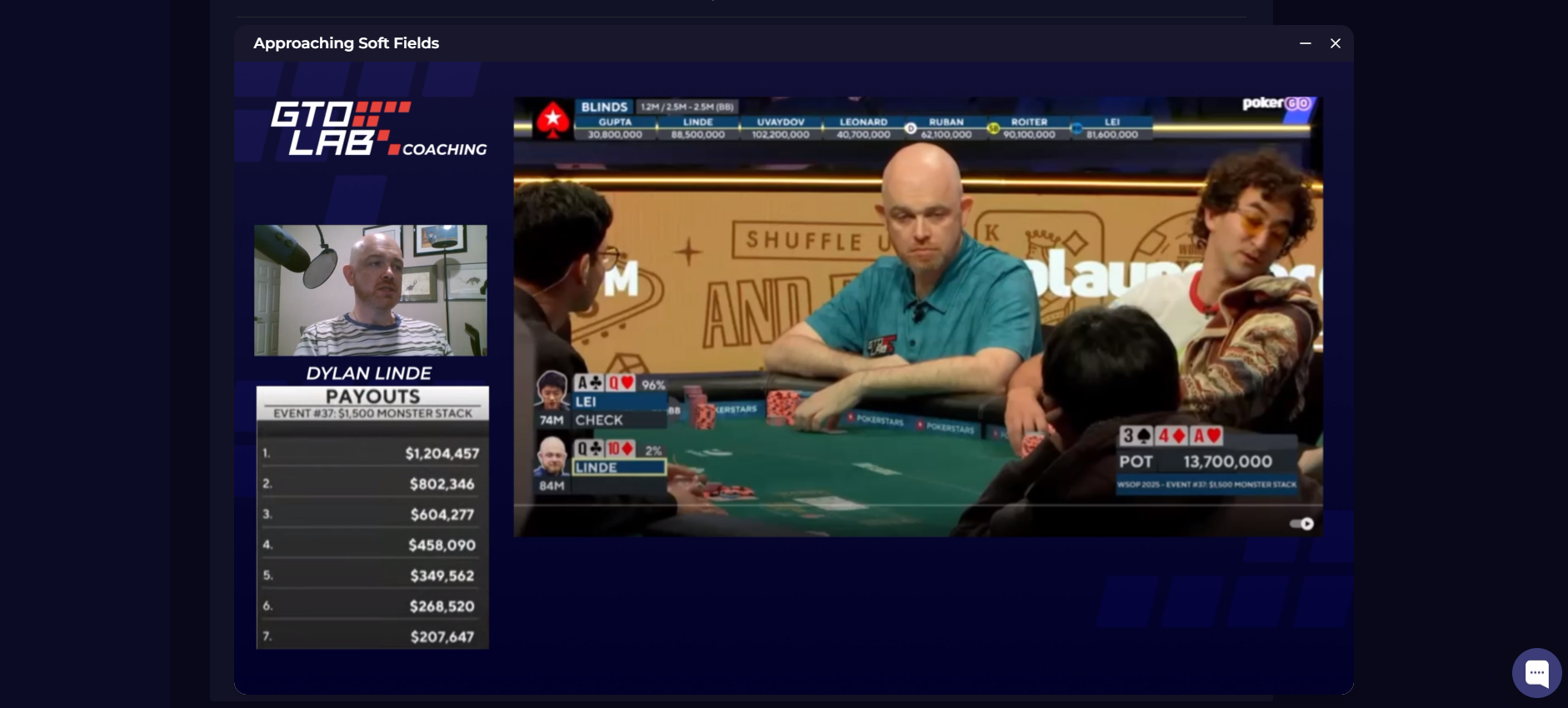
Dylan Linde at the WSOP Monster Stack final table with live payout structure | GTO LAB
What ICM changes about your strategy
Calling ranges tighten significantly
The most direct ICM implication: you need much stronger hands to call off a significant portion of your stack near pay jumps. A hand that chip EV says is profitable can be an ICM mistake the moment the risk premium exceeds 1.5.
“Under ICM against a covering stack, there will be check-backs on boards where chip EV would have you c-betting your entire range. The immediate interesting question is whether your opponent is someone trying to play good theory poker, or someone who’s just p-controlling with hands that don’t want to face a check-raise. That distinction completely changes how you play the turn.”
Nick Petrangelo · Postflop ICM: Strategies for Facing Aggressive Chipleaders | GTO LAB
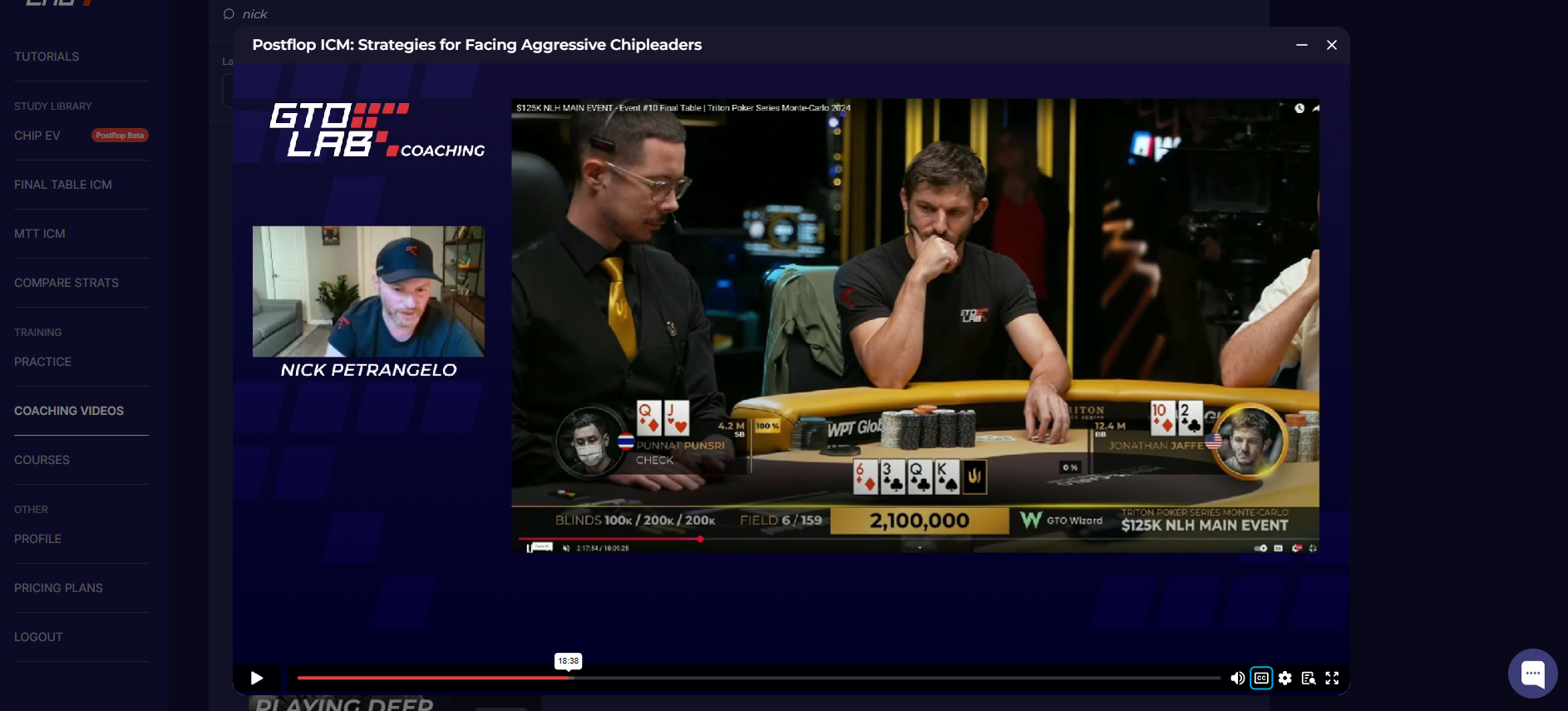
Nick Petrangelo on postflop play vs an aggressive chipleader, Triton $125K | GTO LAB
Aggressive plays become more profitable, not less
This is the counterintuitive half of ICM most players miss. ICM constrains calling ranges, but it simultaneously makes aggressive plays with fold equitmore profitable. When your opponents face the same ICM pressure, their folding frequencies go up. Your steals, squeezes, and pressure bets extract not just chip value but ICM equity from over-folding opponents.
The correct ICM adjustment — both preflop and postflop
ICM tightens calling ranges and makes aggressive plays with fold equity more profitable. Most players learn only the first half and become passive everywhere near money. The correct play: tighten calls, attack ICM-constrained opponents harder.
“It’s really easy to think when you’re at a final table with all world-class players that they will all play exactly like the simulation. The problem is that not only are they not going to play exactly like the simulation, neither will your underanding be complete. The correct adjustment is to read how your specific opponents deviate from theory under ICM pressure, and attack the ones who are over-folding.”
Dylan Linde · Tournament Pressure: Final Table ICM Decisions | GTO LAB
Stack geometry matters as much as your own stack
Your ICM pressure doesn’t just depend on your stack it depends on every stack at the table. A medium stack with two short stacks about to bust faces dramatically less ICM pressure than the same medium stack with those short stacks already gone. The presence of others close to elimination gives you an ICM buffer.
“It’s dangerous thinking in terms that are too vague, or using the wrong terminology when dealing with post-flopop ICM. With certain stack configurations, ranges can get very specific and narrow for the caller. What I want to address is the importance of thinking about the interaction of ICM pressure between the specific players who go post-flopop, not just your own stack isolation.”
Leon Sturm · Core Concepts: Navigating Uncommon ICM Nodes | GTO LAB
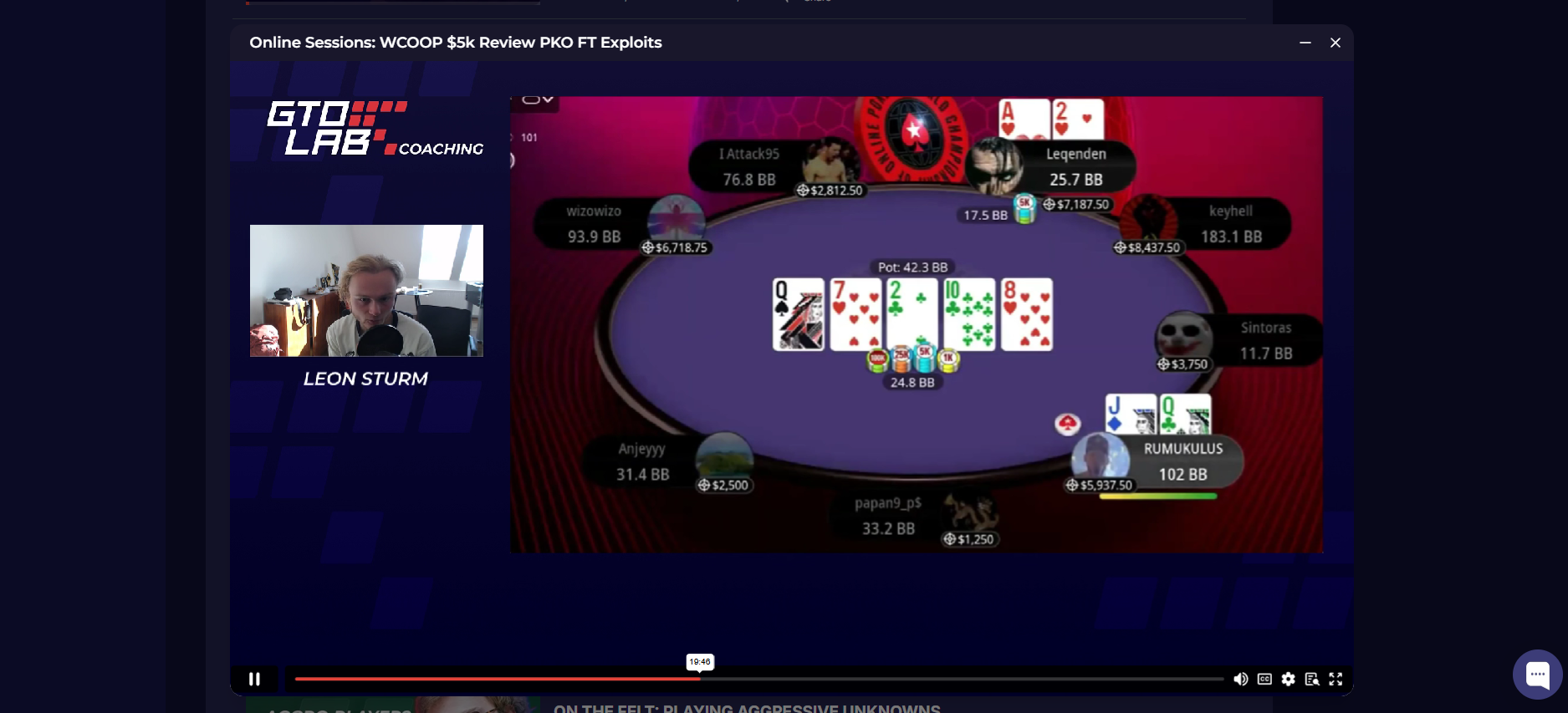
Leon Sturm reviewing a PKO final table, WCOOP $5k | GTO LAB
When does ICM actually matter?
Lean on chip EV
- 80%+ of field still alive
- Bubble is far away
- No significant pay jumps near
- Very early tournament stages
→ Switch to ICM
- Within 2–3 buy-ins of the money
- On the bubble — full guide..
- At the final table — full guide..
- Near any significant pay jump
Where ICM falls short
How to train ICM decision-making
Reading about ICM builds understanding. Training against real ICM solutions builds instincts, which is what actually shows up at the table under pressure. Solvers likPioSolver let you compare chip EV and ICM solutions side by side one of the most efficient ways to internalise what is ICM in poker at a practical level.
“ICM situations are always constantly evolving. Any hand we’re playing is going to be at least somewhat different from any situation we’ve seen before, payout structures are dferent, stack distributions are different, stack arrangements are different. That’s why I prefer full table training over isolated drills. Playing an orbit where you make every decision for every player really reinforces the kind of holistic learning that ICM requires.”
Nick Petrangelo · Study Sessions: How to Actually Improve at ICM | GTO LAB
GTO LAB’s ICM Trainer is built for exactly this. Set up any final table or MTT bubble scenario, make real-time decisions against fully converged ICM solutions, and see the exact dollar cost of every mistake.
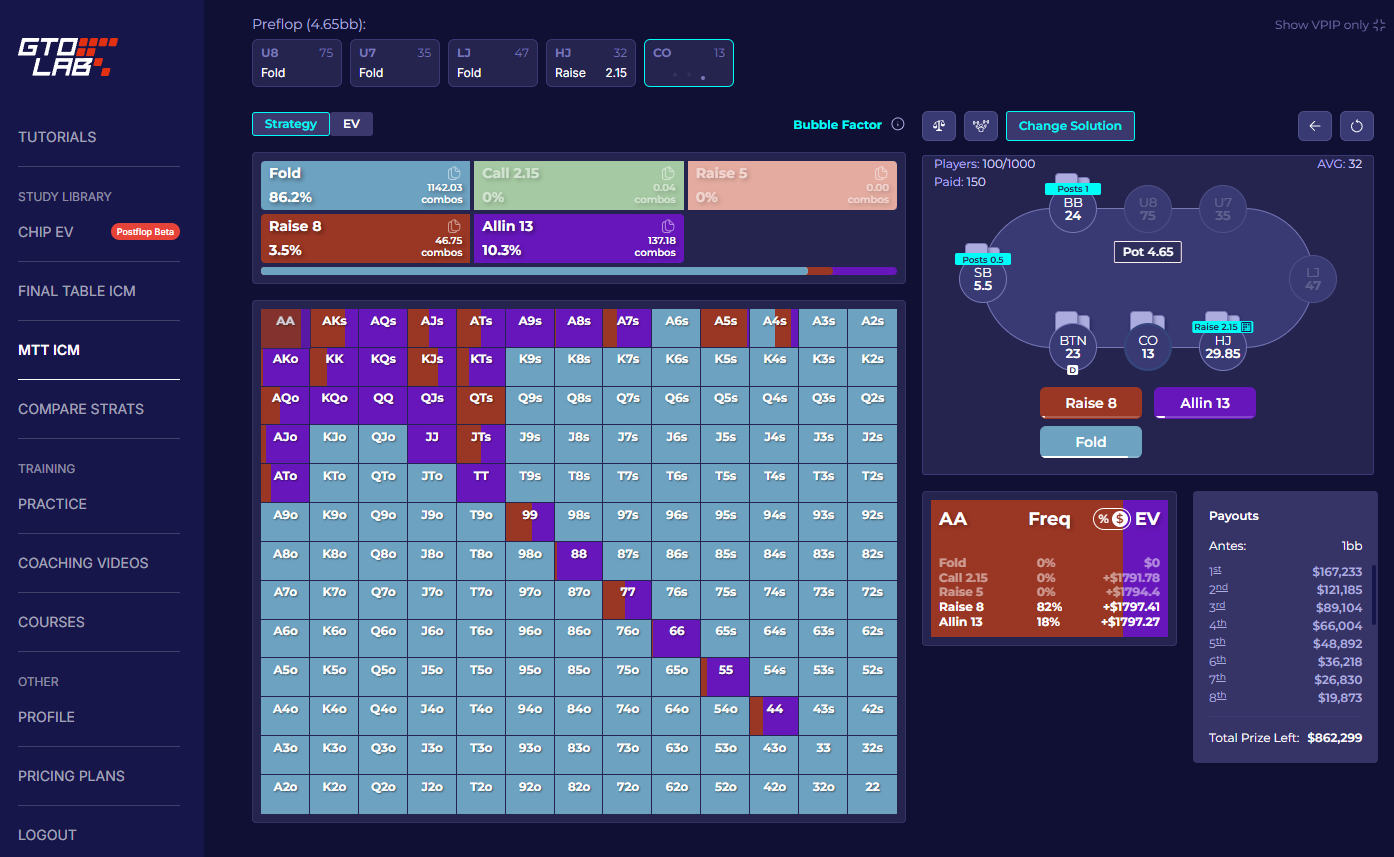
GTO LAB’s ICM Trainer: full table view with decision buttons, range matrix and EV scoring.
For a complete structured course on ICM, Tournament Savagery by Nick Petrangelo and Daniel Dvoress covers 25 hours of content preflop and postflop ICM at every stack depth and stage of tournament play.
Frequently asked questions
What is ICM in poker?
ICM stands for the Independent Chip Model, a mathematical framework that converts tournament chips into real money equity. Because chips have diminishing marginal value in tonaments (winning all the chips doesn’t double your prize), ICM assigns each chip stack a dollar value based on the payout structure and remaining field. It’s the foundation for every ICM strategy decision from the bubble to the final table.
When does ICM actually matter?
ICM pressure builds as pay jumps get larger, it’s near-irrelevant in the early stages but becomes decisive on the bubble, near the final table, and at the final table itself.he bigger the pay gap between eliminations, the more ICM constrains your ranges. At certain final table spots, ICM can cost you 10–15% of your range compared to chip-EV play.
What’s the difference between ICM and chip EV?
Chip EV treats every chip as equal, winning 1,000 chips is always worth exactly 1,000 chips. ICM accounts for the tournament payout structure, so the same 1,000-chip pot is wth more to a short stack and less to a chip leader. See our full breakdown of ICM vs chip EV for the full comparison.
How do you study ICM effectively?
The most effective ICM study combines solver work with active drilling. Use a solver to understand ranges at specific stack depths and pay structures, then drill those spots in an ICM trainer to build real-time intuition. Passive video study alone builds understanding but not the pattern recognition you need at the table. GTO LAB’s ICM Trainer is the only trainer with full-table mode drilling all positions simultaneously rather than one seat in isolation.
Is ICM the same in PKO tournaments?
No PKO (Progressive Knockout) tournaments require a modified model that factors in bounty equity alongside prize pool equity. Standard ICM undervalues aggression against short-stacked covered players and overvalues preservation. PKO strategy requires accounting for the real-time bounty value of each elimination, which changes the calling and shoving ranges significantly compared to a standard MTT.
26 sessions. Preflop and postflop strategy across all stack depths, ICM adjustments for bubble and final table situations, exploitative lines against the mistakes real players make at every stage. Use code NICK26 for $26 off.
About the author