



What you’ll learn
- Why following HRC and GTO Wizard at 50% of field paid is costing you chips you need for the actual bubble.e actual bubble
- The short stack miscalculation that even experienced players get backwards, and why the solver accidentally gets it wrong too.
- Why big stack players at the bubble gamble too much, and medium stacks fold too much, and how to avoid both traps.
- The postflop OOP sizing mistake made at a $200K Triton final table, by an elite regular.
- Why ICM bluffs should not be zero EV at equilibrium, and what that means for your bet sizing.
Most ICM mistakes don’t look like mistakes when you make them. You’re not calling off your stack with 72o. You’re not ignoring the payout structure entirely. You’re following a solver output, playing tight near the money, sizing your bets the way you always do, and you’re losing moneyvery single time.
That’s what makes ICM mistakes different from other leaks. A bad bluff is visible. ICM mistakes are structural they compound quietly across every tournament you play, showing up not in any single hand but in your ROI over hundreds of events.
This guide draws on Nick Petrangelo‘s Tournament Savagery chapters on ICM conditions and Daniel Dvoress‘s postflop ICM framework plus a $200,000 Triton final table hand breakdown featuring Michael Watson and Wiktor Malinowski that illustrates exactly what happens when elite players apply chip EV logic in the wrong context.
Two types of ICM mistakes
Before getting into the specific mistakes, it’s worth separating them into two distinct categories, because the fixes are completely different
Model errors are mistakes in how you think ICM applies to a situation. You’re applying ICM pressure where it barely exists, or ignoring it where it’s extreme. These are conceptual, they don’t show up in a single hand decision, they show up in how you frame the entire stage of a tournament.
Strategy errors are mistakes in execution. You understand roughly where ICM applies, but you’re applying the wrong adjustments: sizing too big postflop, defending too tight from the BB, over-folding to 3-bets. These are mechanical and can be corrected by spending time in the GTO LAB MTT library.
Most coaching content focuses exclusively on strategy errors. This article focuses on both, starting with the model errors, because they’re more expensive and almost nobody tks about them honestly.
Mistake 1: Taking early ICM adjustments at face value
This is the most widespread ICM mistake in tournament poker today, and it flows directly from how most players study.
Open GTO Wizard or run your own HRC sim with 300 players left and 150 paying. The output shows you defending the BB 37% of the time instead of 60% for chip EV. Suited connectors and off-suit gappers disappear from your flatting range. You write it down, study it, apply it at the table, and you’ve just made yoself a worse tournament player.
“At 300 left, 150 pay 50% of the remaining field pay I don’t want to really adjust at all. I think it’s fake. I think that we’re not putting ourselves in a position to have chips on bubbles. We’re not putting ourselves in a position to win tournaments where all the money is at the final table.”
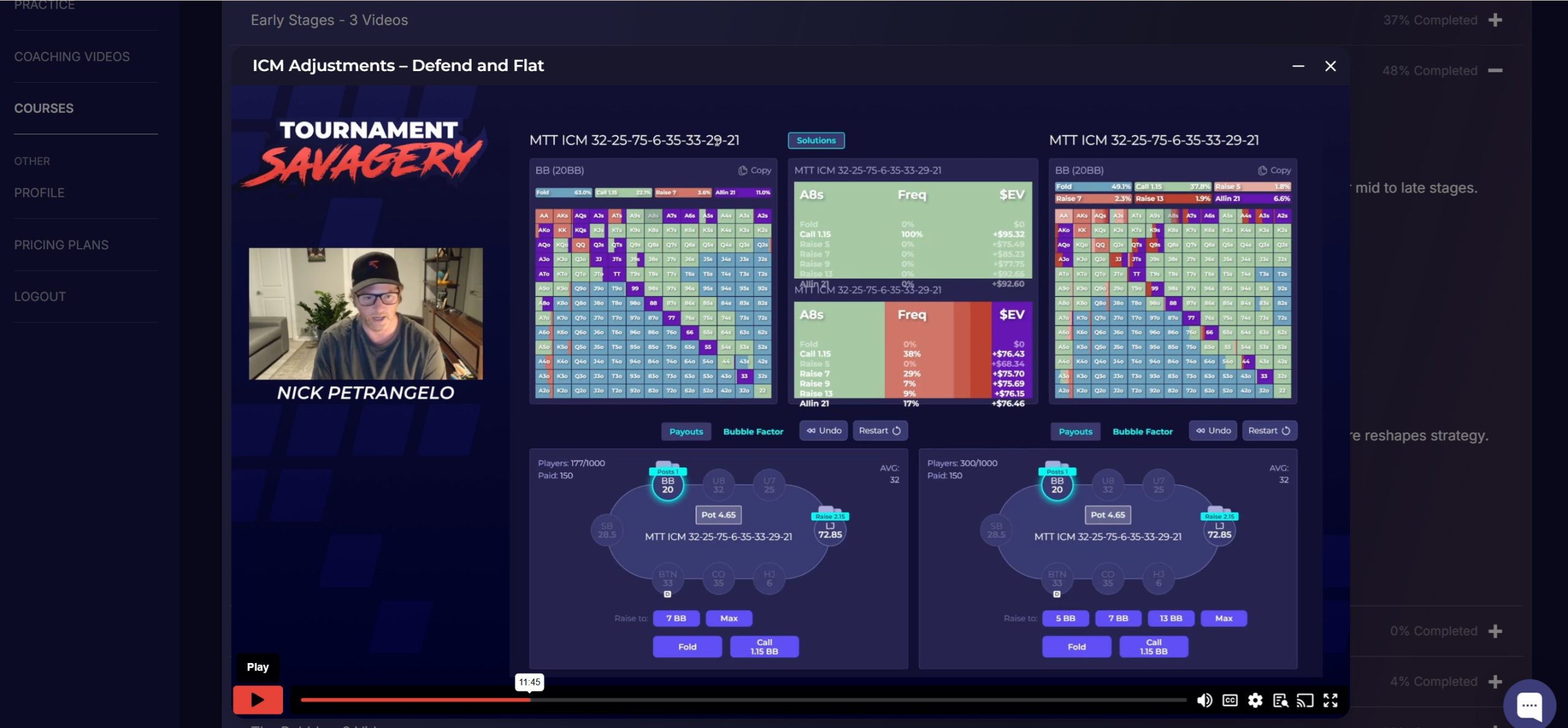
Nick Petrangelo on fake ICM adjustments at 50% paid, Tournament Savagery | GTO LAB
Here’s why the solver gets it wrong at this stage. An ICM solver at 300 left, 150 pay takes current stack ratios and forecasts finishing positions to calculate dollar equity. It does not understand that you’re going to play hundreds of hands before you reach the bubble. It doesn’t understand skill edge. It doesn’t understand future game value. It sees the 2:1 chip ratio between you and the chip leader and concludes that folding your T8s right now preserves more equity than putting in 2 big blinds.
That logic is only approximately correct when you’re actually close to the money. 150 players away from the bubble, it’s essentially fiction. The practical cost: you’re folding J9s, T8s, and off-suit gappers that have clear chip EV value, at precisely the stage ere chip accumulation for the actual bubble matters most.
The correction is not to ignore ICM sims at this stage, it’s to use them interpretively. The adjustments become reliable as proximity to real pay jumps increases. At 85% of fld paid, bubble factors are genuinely elevated. On the stone bubble itself, the model is quite accurate. The lesson: ICM sims are only useful when applied at the right stage.
Mistake 2: Thinking about short stacks in terms of big blinds, not stack average
Ask most players what it means to be short near the bubble and they’ll say something like “under 15 big blinds.” That framing leads to a specific, costly error that goes against every intuition.
Here’s the counterintuitive result. Two stone bubble situations: in the first, you have 10 big blinds with a field average of 22 big blinds. In the second, you have 6 big blinds with a field average of 40 big blinds. Which situation has the higher risk premium?
Most players answer: the second, you have 6 big blinds, it’s desperate, gamble it up. The correct answer is the first. The 10 big blind stack has the higher risk premium and ould call wider. The 6 big blind stack should actually call tighter.
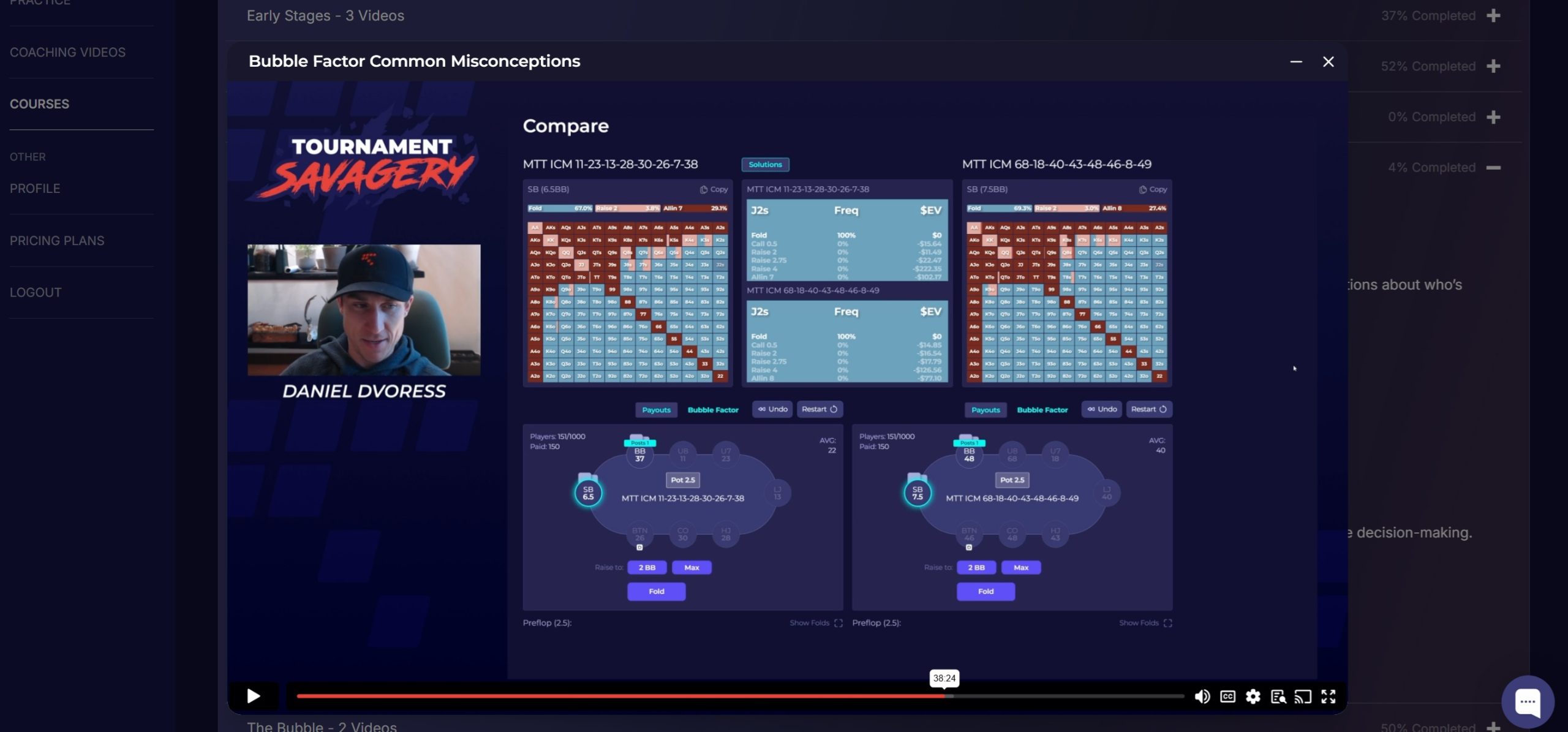
Daniel Dvoress on short stack vs field average, Tournament Savagery | GTO LAB
The reason is the value of accumulating chips. With 10 big blinds into a 22 big blind average, doubling gets you to approximately average stack, a meaningful improvement in trnament equity. With 6 big blinds into a 40 big blind average, doubling gets you to 13 big blinds. You’re still going to min-cash the vast majority of the time regardless. There’s almost no benefit to risking your tournament life for chips you can’t use.
The question to always ask near the money: if I win this hand, does it meaningfully change my tournament situation? If doubling gets you to average or puts you in contention for pay jumps your risk premium is probably lower than instinct suggests. If doubling just means you min-cash a bit more reliably your risk premium is very high, even if your stack looks desperate in absolute terms.
| Scenario | Your stack | Field avg | If you double | Risk premium |
|---|---|---|---|---|
| Stone bubble | 10bb | 22bb | ~avg stack, real upside | Higher call wider |
| Stone bubble | 6bb | 40bb | 13bb still min-cashing | Very high, call tight |
Mistake 3: Big stacks gambling too much, medium stacks folding too much
These two opposite mistakes tend to happen simultaneously at the same bubble table, and understanding them as a pair is more useful than treating them separately.
Big stack players at the bubble often treat their chip lead as a license to gamble. They open wide, call off light, and play as if the ICM pressure on everyone else doesn’t constrain their own decisions. The logic feels right, big stacks face less ICpressure, so they should be more aggressive. That’s true. But “less constrained” is not “unconstrained,” and the mistake is taking it to that extreme.
Large chip movements under ICM pressure leak equity to uninvolved players regardless of who initiates them. A chip leader who builds a massive pot in a marginal spot is giving away real money to the six other players at the table who weren’t involved and who just watched two stacks collide.
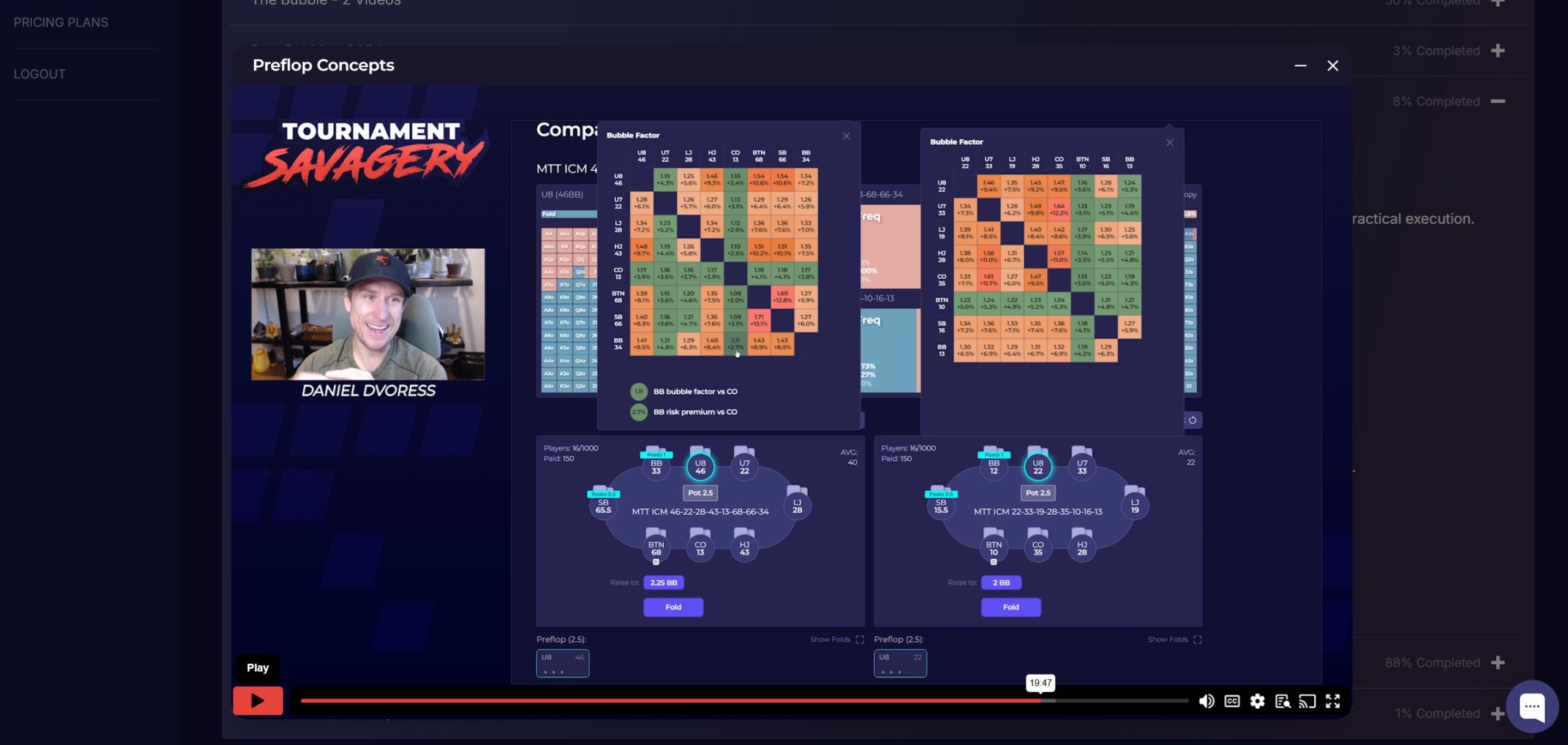
Daniel Dvoress on big stack and medium stack bubble mistakes, Tournament Savagery | GTO LAB
The medium stack mistake is the mirror image and arguably more common. A player with roughly average chips near the money often develops ICM paralysis, a binary mindset that tats every decision as “do I want to risk busting the tournament?” That leads to folding profitable spots, calling with ranges too tight for the actual risk premium, and playing a strategy that is inferior to chip EV in many spots where ICM pressure is moderate rather than severe.
The solution for medium stacks is to play much closer to chip EV than instinct suggests, especially in pots that are small relative to the stacks involved, where you’re not pying for tournament life, and where post-flop skill advantage outweighs the marginal ICM cost. Defending the big blind with T8s against the chip leader’s wide open is not ICM suicide. It’s putting in 1 big blind to play a profitable hand.
Mistake 4: Drawing false conclusions from solver outputs
This one affects players who study seriously, the ones who open the GTO LAB library, look at the ICM outputs, and confidently conclude the wrong thin
A common example: you’re near the bubble in the BB and you see your call-off range is tighter than chip EV. You conclude: “I’m calling tighter because there’s more ICM pressure.” That’s often the wrong conclusion. In many near-bubble configurations, you’re calling tighter because your opponent’s jamming range is tighter not because your own risk premium increased. The strategy changed, but not for the reason you think.
Why does this matter? Because if you misattribute the cause, you’ll apply the adjustment in spots where it doesn’t belong, including configurations where the opponent is actuly jamming wider than normal, meaning your call-off range should be looser, not tighter.
The discipline required: go to the response node, not just the strategy node. Before forming a conclusion about your own strategy, look at what your opponent is doing to produce it. What is their open frequency? Their jamming range? Their folding frequency to your 3-bet? The output is always a response to something specific, and if that something dsn’t match what you’re facing, the output is unreliable.
A related version of this mistake: looking at EV figures without converting them to intuitive numbers. “+$440” in a million-dollar prize pool tournament is meaningless as stated. Converting it, 150 players left, avera stack 30bb, prize pool $1M, so average stack is worth ~$6,000, so you’re playing approximately 100-200 turns that number into something actionable. That’s 0.3 big blinds at 100-200. A meaningful mistake per action.
Mistake 5: OOP postflop sizing — the mistake even elite regs make
Everything above has been a preflop or model error. This one is postflop, and it may be the most instructive in the entire list, because it was made at a $200,000 Triton Montegro final table by one of the strongest tournament players in the world.
In a GTO LAB breakdown of a hand featuring Michael Watson and Wiktor Malinowski, Nick Petrangelo and Daniel Dvoress breaking down the OOP postflop sizing mistake, even at the $200K levelHJ. Malinowski covers him from the button. They see a flop with a double flush draw texture. Watson check-raises large.
That’s the mistake. Not check-raising that’s fine. The size.
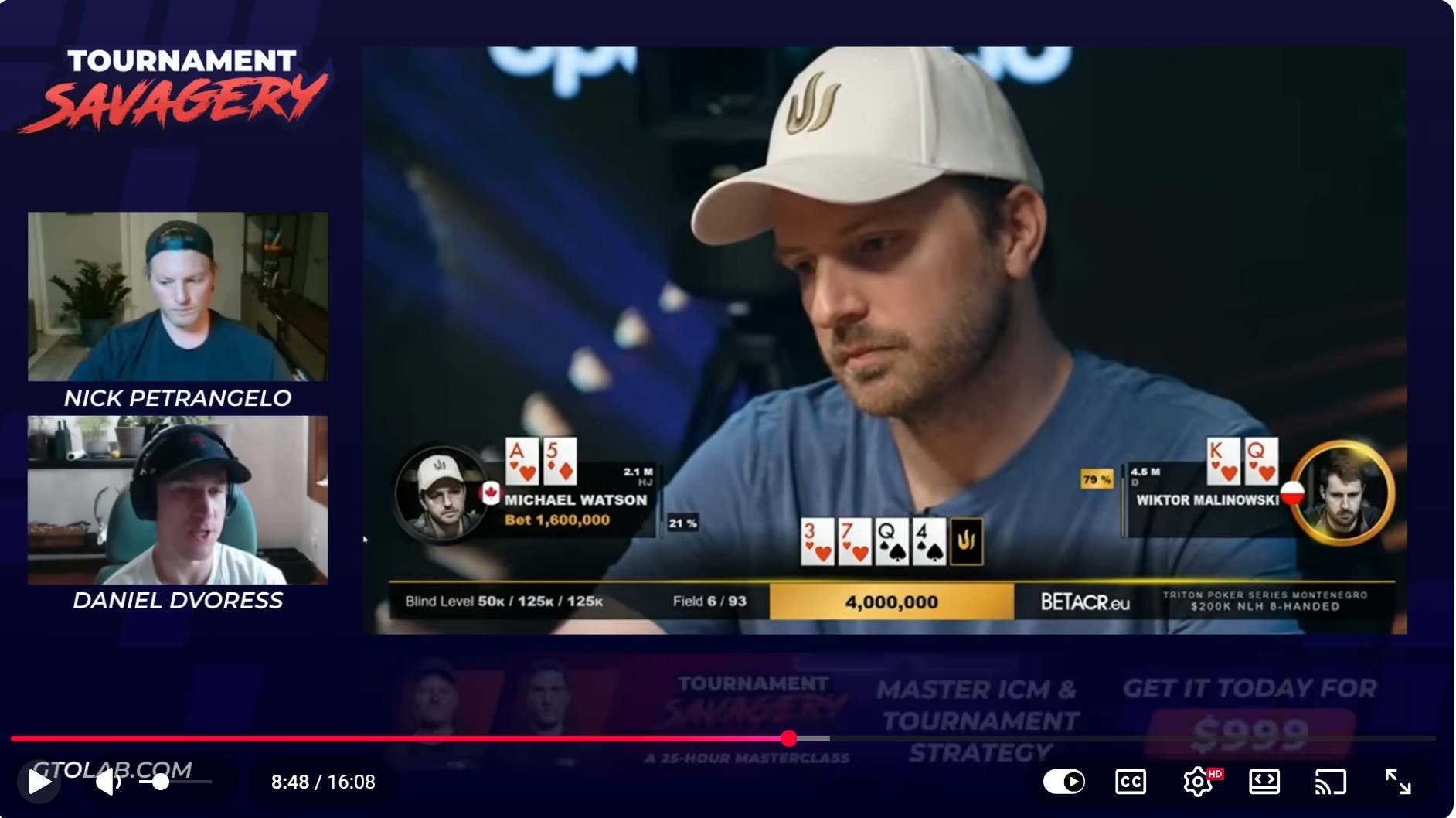
Nick Petrangelo and Daniel Dvoress breaking down the Watson vs Malinowski hand. GTO LAB YouTube.
“The most important thing we want to get across is to take whatever strategy you think you want to play for chips, polarize it a little bit, but most importantly, play smaller sizes. Under ICM pressure, you want to avoid risking your tournament life unnecessarily by sizing down and building lines that keep you out of big all-in confrontations unless you have a very strong hand.”
Daniel Dvoress · Even Elite Regs Make Mistakes at Final Tables | GTO LAB YouTube
On a double flush draw board for chip EV, you go geometric with a polarised range, front-load the pot, use big sizing. Correct chip EV logic. But under ICM pressure, every ch Watson puts in is worth more on the way out than on the way in. The 1.6 million chip bet is effectively a 2.4 million chip bet in real dollar terms, because the chips he risks losing are worth significantly more than the chips he ands to win.
Nick’s correction: Watson should have gone to 500K on the flop instead of large. With a deeper effective SPR going into the turn, he could continue with a smaller bet. If bluffing, the right candidates are hands like the ace of hearts and five of spades, bluffs that cost less toun when they don’t work. Watson received a king on the river and waved the white flag, having risked considerably more than the spot required.
Nick Petrangelo and Daniel Dvoress breaking down the OOP postflop sizing mistake even at the Triton level.he $200K level
Mistake 6: Treating ICM bluffs as break-even, they shouldn’t
This is the most theoretically precise of the six mistakes, and it has direct implications for your bet sizing under ICM pressure.
For chip EV, calls at equilibrium are often approximately zero EV for the caller, they’re indifferent calls, exactly at the point where calling and folding are worth the sameThat’s what equilibrium looks like for chips. Under ICM pressure, that indifference point disappears.
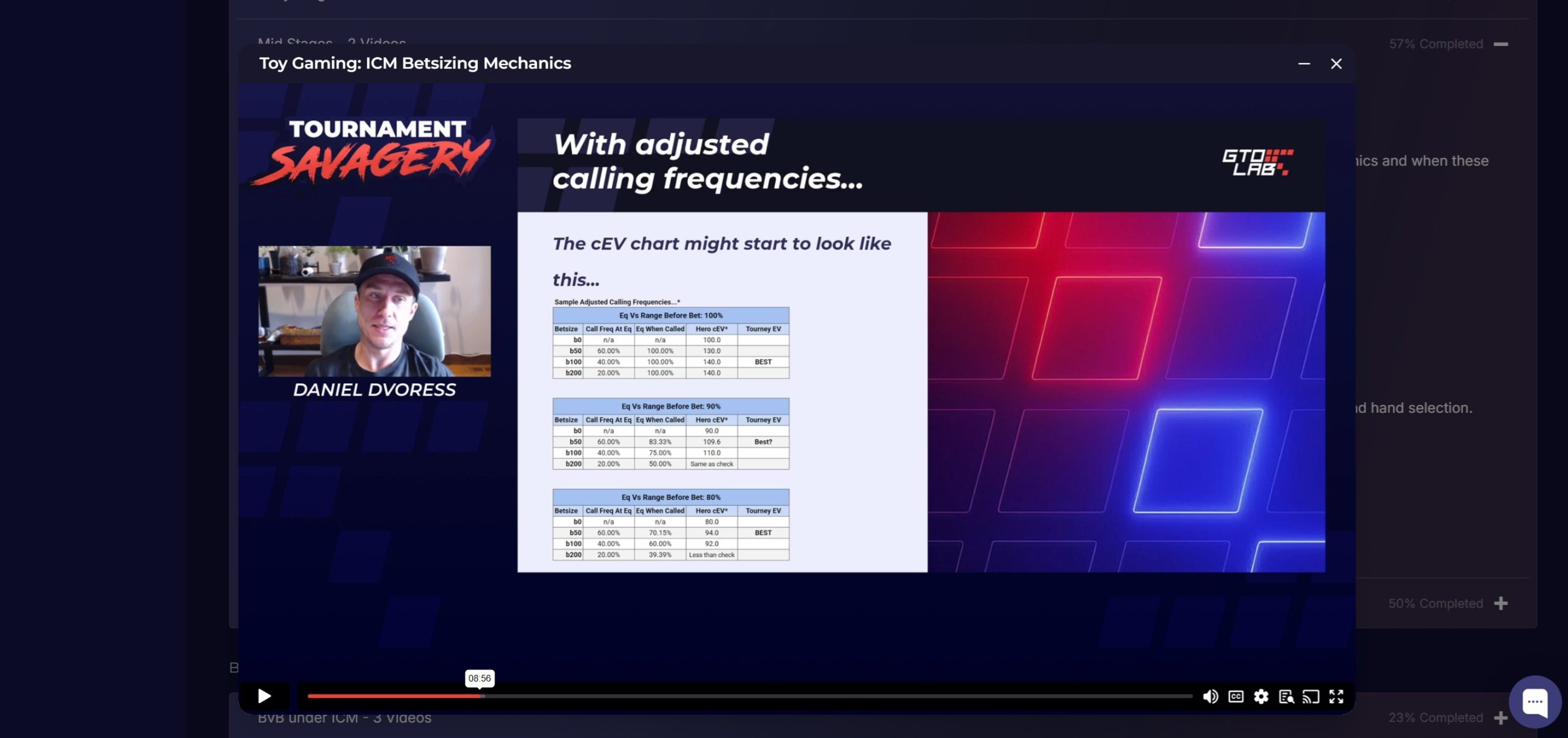
Daniel Dvoress on postflop bet sizing under ICM pressure, Tournament Savagery | GTO LAB
When there is meaningful ICM pressure, your bluffs should be slightly profitable at equilibrium, not break-even, actually slightly positive. The reason: losing chips under ICpressure is worth more than winning the same number of chips. That asymmetry means calling thresholds are higher for your opponent, which means they fold more than chip EV MDF suggests, which means your bluffs, correctly sized, are modestly prable on average.
The practical mistake this reveals: players running large bluffs under ICM pressure may be generating chip EV but losing tournament EV. When those bluffs get called, they’re losing chips worth more than the pot. Smaller bluffs, run more selectively, at sizes that keep the pot manageable, that’s the correct ICM justment.
This also affects sizing even when you have value hands. If you’re using large bets under ICM pressure and getting called at a fraction of the frequency chip EV MDF would require, you might look profitable. But large movements of chips at a table with significant ICM pressure leak equity to the uninvolved players regardless of whether you win the individual hand.
How to fix these mistakes
The six mistakes above range from conceptual to mechanical, and the fixes are different for each category.
For model errors (Mistakes 1 and 2): the fix is building better mental frameworks before you sit down not studying more solver outputs. Train yourself to ask at every significant tournament stage: how useful is chip accumulation right now, given the payout structure and my stack relative to average? That question, asked consistently, prevents most fake-ICM adjustment errors and most short stack miscalculations.
For solver misinterpretation (Mistake 4): always go to the response node before forming a conclusion about your own strategy. The GTO LAB MTT library is structured specifically to let you trace these dependencies. Depth of understanding per hand matters more than the volume of hands studied.
For postflop sizing and bluffing errors (Mistakes 5 and 6): use the rule Daniel and Nick state explicitly take your chip EV strategy as the starting point, and size down from there. Not by a fixed percentage, but based on how heavy the ICM pressure actually is in the specific configuration. The Watson hand is worth watching not because it shows a catastrophic mistake, but because it shows a subtle one made by an elite player who knew exactly what he was doing.
Frequently asked questions
When should I actually start making ICM adjustments in a large-field MTT?
When proximity to real pay jumps becomes meaningful. In most large-field tournaments this means roughly 15-20% of the remaining field from the money, not 50%. The closer you t to that threshold, the more the solver’s bubble factor calculations reflect what’s actually happening in the tournament. On the stone bubble itself, the model is quite reliable. In the early stages and well before the money, treat the ICM sims as informational rather than instructional.
Is it always wrong to follow HRC or GTO Wizard near the money?
No the tool is right about the direction of adjustments in most cases. The problem is the magnitude, especially far from the bubble. The solver doesn’t understand future hands, skill edges, or the compounding value of chip accumulation before the real pressure begins. Use the sims to understand which hands tighten and which ranges shift, but apply those findings with context. At stone bubble situations, the outputs are generally reliable. At 300 left and 150 paid, treat them as a rough guide, not a playbook.
How much should I size down postflop under ICM pressure?
There’s no fixed rule it depends on the actual ICM pressure in the spot. With light pressure (covering everyone, bubble is far), the departure from chip EV sizing is small. With severe pressure (you’re covered, short stacks are nearby, large pay jumps imminent), the reduction is significant. The starting point is always your chip EV strategy. From there, size down in proportion to how much the chips you’re risking exceed the value of the chips you stand to win.
Does this apply to online tournaments the same way as live?
Yes, the principles are universal, but calibration differs. Online fields tend to be faster-structured with shorter bubble periods, which means the “far from the money” zone smaller and the stone bubble arrives sooner in terms of real time. Live tournaments often have longer blind levels and more hands before the bubble, which makes the “don’t over-adjust early” principle even more important. The payout structure, particularly how top-hey it is also varies more in online formats and has a significant effect on when accumulation vs. survival becomes the priority.
What’s the most common ICM mistake at the final table specifically?
At the final table, the dominant mistake shifts to the postflop sizing errors covered in Mistakes 5 and 6. Preflop ICM awareness is generally higher among players who reach final tables. The gap is in postflop, specifically OOP bet sing, where players continue applying chip EV geometric sizing in spots that demand significantly smaller bets. The Watson hand is emblematic: not a preflop mistake, not an ignorance-of-ICM mistake, but a precise mechanical error in how the hand was built from the flop.
Common ICM mistakes: key takeaways
ICM sims at 50% of field paid are not a reliable playbook the solver can’t model future hands, skill edge, or chip accumulation value. Play closer to chip EV until you’re genuinely close to a real pay jump
Short stack risk premium is determined by stack relative to field average, not absolute big blinds a 6bb stack into a 40bb average often has a higher risk premium than a 10bb stack into a 22bb average
Big stacks at the bubble tend to gamble too much, medium stacks tend to fold too much both errors arise from misreading the actual level of ICM pressure in a spot
When reading solver outputs, always go to the response node your strategy is shaped by what your opponent does, not just your own risk premium. False conclusions come from reading only the strategy grid
OOP postflop under ICM pressure: take your chip EV strategy and size down the chips you risk are worth more than the chips you stand to win, so geometric sizing destroys value even with strong hands
At ICM equilibrium, bluffs should be slightly profitable not break-even. Opponents fold more than chip EV MDF suggests. Oversized bluffs leak equity even when they work
Ready to apply this?

26 sessions. Preflop and postflop strategy across all stack depths, ICM adjustments for bubble and final table situations, exploitative lines against the mistakes real players make at every stage. Use code NICK26 for $26 off.
ICM Strategy — Complete Guide
→ ICM vs Chip EV
→ ICM on the Bubble
→ Final Table ICM
→ Common ICM Mistakes (you are here)
→ Short Stack ICM (coming soon)
→ Big Stack ICM (coming soon)
→ ICM in PKOs (coming soon)
→ Postflop ICM (coming soon)
→ How to Study ICM (coming soon)