


What you’ll learn
- How to read a final table before you play a single hand
- Why flat vs. top-heavy payout structures demand opposite strategies
- The big stack, medium stack, and short stack playbooks, with real solver data.
- Where ICM pressure spikes and how to anticipate it before a hand is dealt
- How postflop strategy changes under final table ICM pressure
- How Triton, WSOP, and GGMillion$ final tables each require different calibrations
You’ve played thousands of hands to get here. Now the final table begins and almost everything changes.
The ranges tighten. The pay jumps are real money. Bet sizing that was optimal six hours ago will now torch your equity. And the mental game shifts in ways most players never prepare for.
This guide breaks down final table ICM from the ground up, pulling from GTO LAB coaching sessions across three very different tournament environments: the ultra-high-stakes short-field pressure of Dylan Linde and Ben Heath at Triton, the massive-field ICM dynamics of the WSOP Main Event, and the flat-payout online grind of the GGMillion$ reviewed with Nick Petrangelo. The principles are universal. The calibration differs by field.
Why the final table is not just another stage
Most players understand ICM abstractly. At the final table, it becomes immediate and expensive.
Every spot now lives inside what Daniel Dvoress calls the macro frame before the micro frame. Before you look at your hand, you need to assess the environment: the payout structure, your stack relative to everyone else, your table position, and how much ante is in the middle.
“Most players, when they’re at a final table and they look at their hand, they make emotional decisions. They react to a hand one-dimensionally. When instead they should really look at all the environmental circumstances they’re in. The best advice I can give you is to go from the macro frame into the micro frame whenever you have a decision.”
Klemens Roiter · WSOP 2025 Monster Stack FT — ICM & FGS | GTO LAB
Klemens Roiter on Monster Stack final table ICM and Future Game Simulation | GTO LAB
That framework, structural factors first, hand decision second, is what separates final table specialists from players who just happen to run deep. Four things to assess befevery hand:
| Factor | What to assess | Why it matters |
|---|---|---|
| Payout structure | Flat or top-heavy? 1st:5th ratio? | Changes survival value vs. chip accumulation priority |
| Stack geometry | Who covers whom? | Covering relationship constrains decisions before any hand is dealt |
| Seat quality | Covering stacks left/right? Short stacks attackable? | Determines your ICM exposure per orbit |
| Ante format | Live BB ante vs. online every-player ante? | Changes dead money and shove thresholds significantly |
Payout structure: the most underrated variable
Not all final tables are created equal. The ratio between first and fifth place money determines your entire strategic posture, and it’s something most players completely igne.
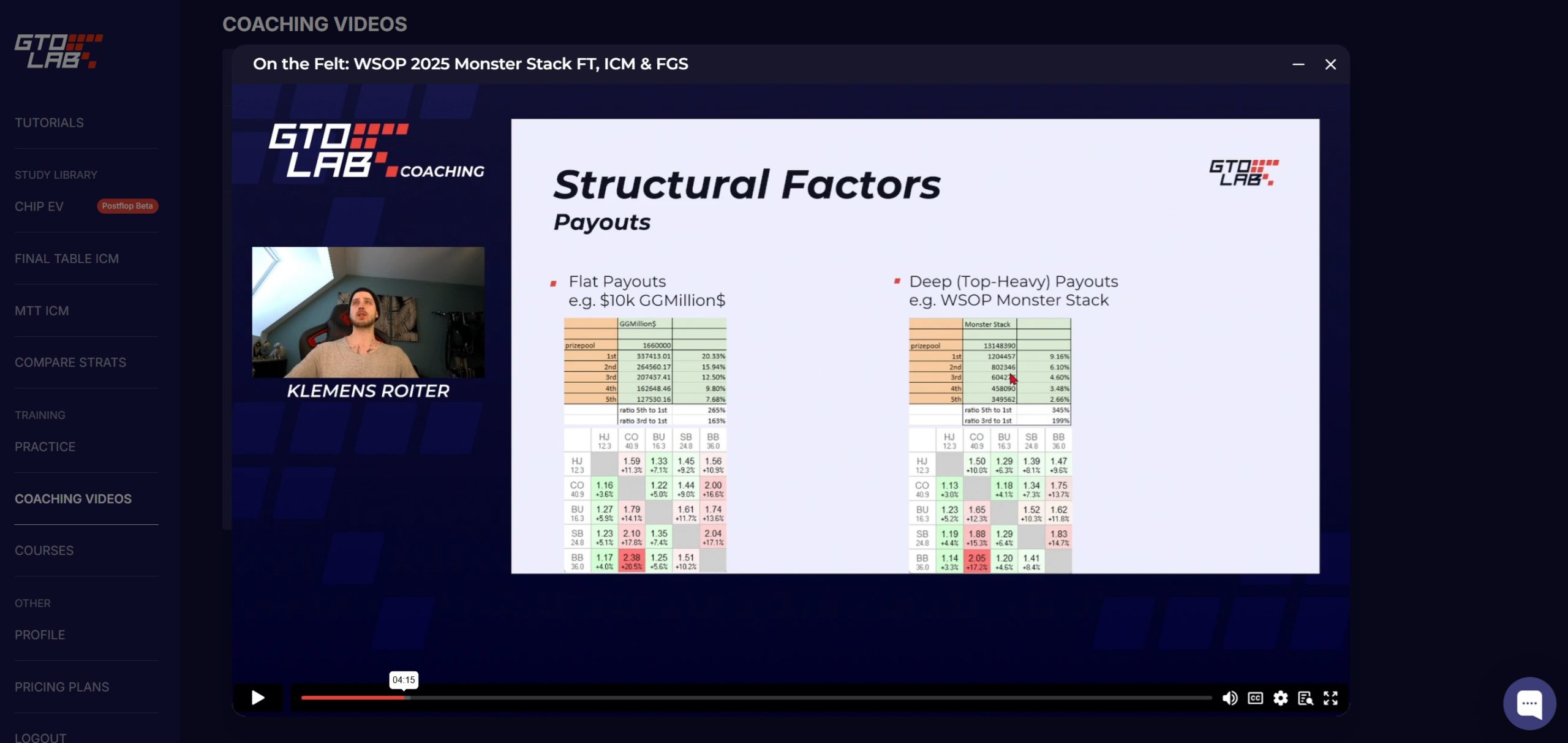
Klemens Roiter compared two structures directly in his Monster Stack breakdown. In the GGMillion$ $10K final table, the gap between 5th and 1st is just 2.65x. In the WSOP Monster Stack which Roiter won that same gap is 3.45x. Same number of players, same stack depths, completely different strategic implications.
The most common misconception
Bigger first prize does not mean you should play more conservatively. It means the opposite. In top-heavy structures, your stack’s ability to actually win the tournament drives your EV. Over-folding to ladder gives away first-place equity you can never recover.
The bubble factors tell the story numerically. With identical five-handed stack sizes, the player under maximum pressure in the GGMillion$ flat structure faces a 20.5% risk premium. In the Monster Stack’s top-heavy format, that same player faces only 17.2%. The flat structure actually punishes risk-taking more harshly at each pay jump.
| Structure | 1st : 5th ratio | Risk premium (5-handed) | Strategic implication |
|---|---|---|---|
| GGMillion$ $10K (flat) | 2.65x | 20.5% | Survival matters; take moderate risks |
| WSOP Monster Stack (top-heavy) | 3.45x | 17.2% | Accumulate chips; first-place equity dominates |
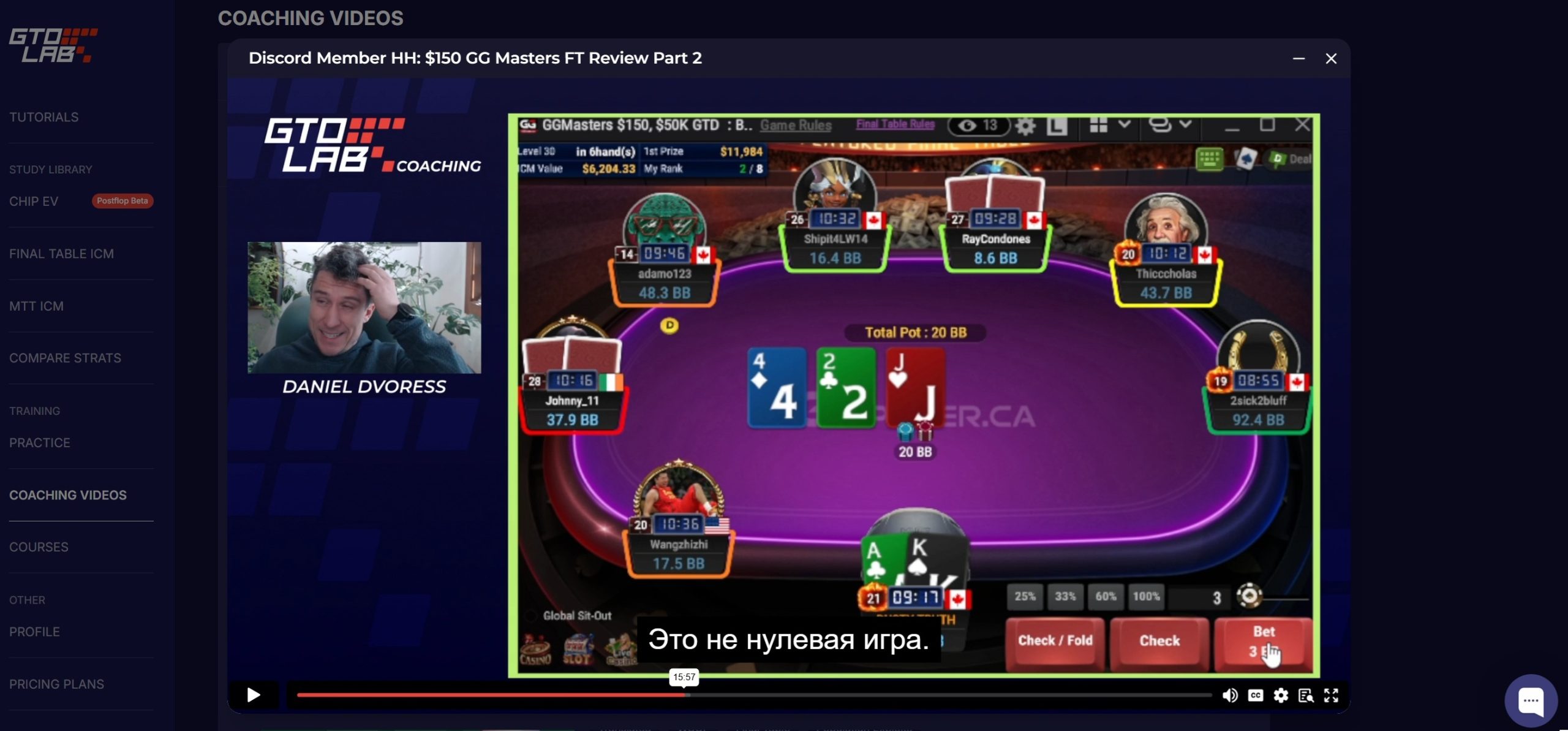
Daniel Dvoress reviewing GGMasters final table dynamics | GTO LAB
Ante format: the variable nobody talks about
Live poker uses a big blind ante posted by the big blind. Online poker uses an every-player ante. At short-handed final tables, these formats produce meaningfully different pot sizes relative to stacks, which changes shove thrholds for everyone at the table.
The Monster Stack FGS data makes this concrete. Three-handed with a BB ante, a 7BB stack shoving from the button operates on a 32.6% shove frequency under standard ICM. Add FGS and that range expands to 46.9% because the value of surviving to see two larger stacks clash is enormous. When you transition from online to live final tables, your short-stack shove ranges should tighten noticeably. Hands that are clear shoves in the GGMillion$ become close spots at a live WSOP final table with the same BB depth.
Stack geometry: how covering relationships shape every hand
The most important pre-hand variable at any final table is the covering relationship between stacks. As Daniel Dvoress teaches in Tournament Savagery: the covering stack handcuffs the entire table before any action begins.
When a massive chip leader sits to your left, even your strong hands carry ICM risk you can’t eliminate. You can have a 58% equity advantage on a board, as seen iBen Heath‘s Triton $100K Jeju hand review and still face a fundamentally different strategic calculus than a chip EV spot with the same equity, because you’re covered by a player who can end your tournament at any point.
- Short stacks fear the covering chip leader most and tighten often more than ICM actually requires at pay-jump boundaries.
- Mid stacks balance survival against accumulation, typically shifting to 3-bet-or-fold below around 28–30BB.
- Big stacks have the most theoretical freedom but face a trap Nick Petrangelo calls the “pyramid of weak hands.”
The big stack playbook
Chip leaders make a predictable mistake: they believe their stack means they can open anything and bully freely. In practice, as Nick Petrangelo explains in his Tournament Savagery modules, chip leaders end up with opening ranges stuffed with weak, dominated holdings suited one-gappers, weak aces, low broadway hands because they lean on stack size rather than hand strength.
“The chip leader’s range isn’t the intimidating polar range people imagine. It’s more like a pyramid of weak hands dominated holdings that sharp mid-stack opponents can pick apart systematically.”
Nick Petrangelo · Tournament Savagery: Playing the Big Stack | GTO LAB
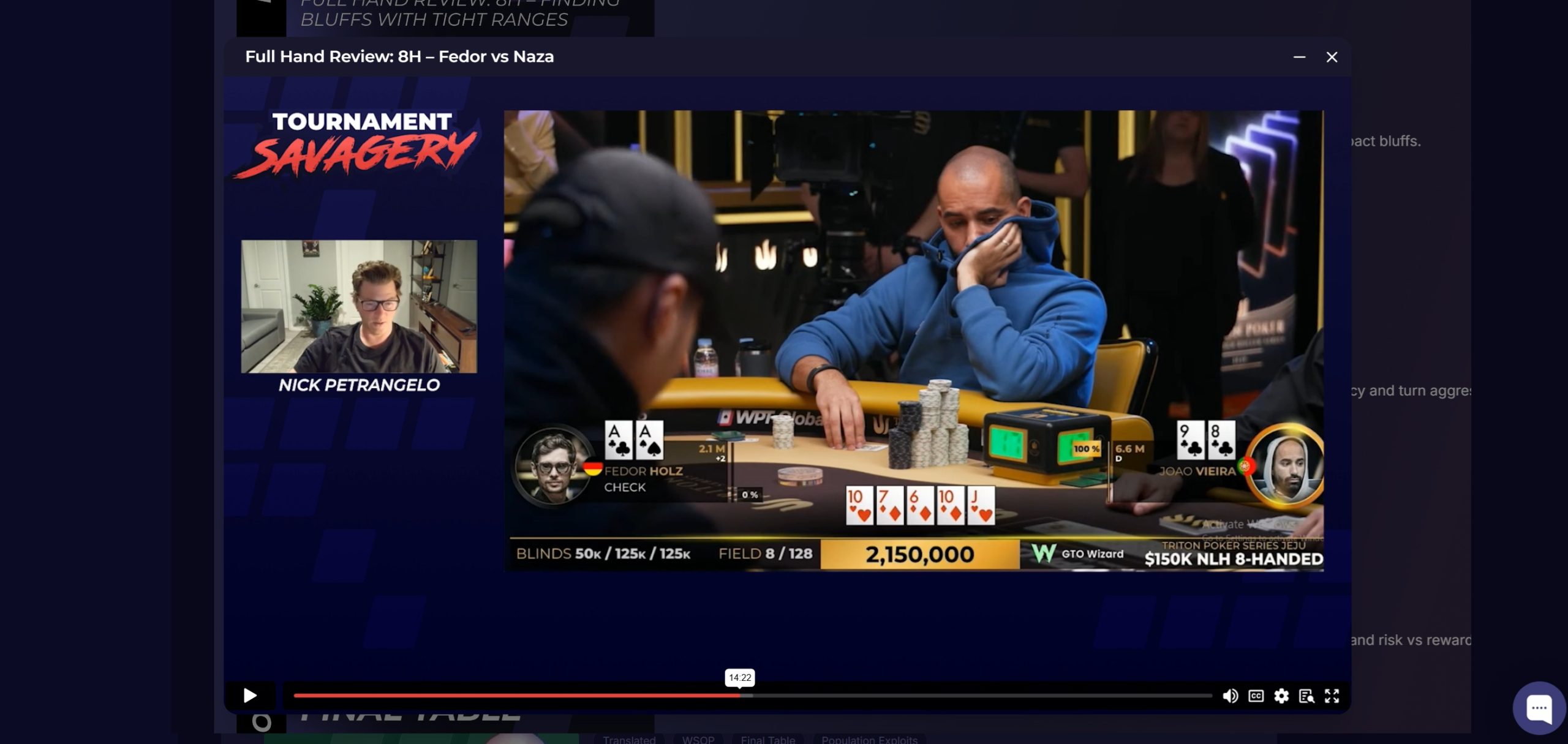
Nick Petrangelo on playing the big stack at final tables, Tournament Savagery | GTO LAB
Attack medium stacks, not short stacks. Short stacks who are desperate will call with wide ranges and race you. Mid stacks protecting their tournament life are far more likely to fold equity to pressure.
Tighten into covered big blinds, not widen. Ben Heath‘s analysis of the Triton $100K Jeju final table shows a UTG range that excluded even 88 in certain configurations, because the combination of tight BB defense and multiple covering stacks behind made marginal hands unprofitable despite the chip advantage.
Use two sizes postflop, not one. Dylan Linde‘s Triton Monte Carlo analysis shows big stacks deploying a small size for linear value extraction and a polarized large size for strong hands or bluffs, never one-dimensional lge-bet aggression that telegraphs the distribution.
The medium stack playbook
The medium stack is the most complex position to play at a final table. You have enough chips to be dangerous but enough ICM exposure to be genuinely constrained. The critical threshold is roughly 28–30BB.
Above 30BB, flatting becomes viable. You can see flops, realize equity, and avoid unnecessary variance. Ben Heath articulates the medium stack’s best situation in the GGMillion$ high-stakes review: when two chip leaders clash in a massive pot, the medium stacks’ optimal play is often to stand back entirely and collect free pay jumps while the big stacks bleed each other out.
Below 28–30BB, 3-bet-or-fold becomes the dominant regime. Flatting in this zone creates awkward SPRs where you’re either forced into a bad call-or-fold or checking back the flop out of ICM fear and surrendering the initiative.
Key insight
At 20–28BB under ICM pressure, small pocket pairs can appear as 3-bet bluffs, not to get stacks in, but to clear overcards from the opener’s range and play heads-up with posion. The EV comes entirely from fold equity. If your mental plan assumes a call with depth, the 3-bet is wrong.
The short stack playbook
The short stack faces ICM pressure at its most acute, but also the most quantifiable. ThTournament Savagery final table modules break this down across two key configurations: short-stack play with 6+ players remaining, and bubble factor mechanics from 5–3 players left.
The core lesson from Ben Heath‘s Triton $100K Jeju analysis: stack-off thresholds rise sharply under ICM from multiple covering stacks. A UTG9 opening range at that final table excluded even ATo as a defend against a larger open, because the combinationf a very tight opener and two large covering stacks behind made marginal calls unprofitable at every equity percentage you might assume is safe.
Over-tightening from early position. Waiting for premiums that never come while the blinds eat the stack. The correct play is to find accumulation spots before desperation forces a 5BB shove-anything situation.
Under-tightening in call-off spots. Calling off against chip leader 4-bets with KJo or A8s. The chip leader’s opening range is wide but when they 4-bet, it narrows to exactly the region that dominates those hands.
The FGS adjustment is where short stacks recover equity. The difference between 32.6% (ICM) and 46.9% (FGS5) on a 7BB BTN shove is not a small edge case. It’s material, and it comes from the vae of surviving one more orbit while larger stacks clash.
Pay jump mechanics: when ICM pressure spikes
ICM pressure doesn’t rise linearly as players are eliminated. It spikes at specific structural moments and understanding where the spikes occur lets you anticipate opponent behavior before a hand is dealt.
| Trigger | What happens | How to exploit |
|---|---|---|
| Last spot before major jump | Short stacks fold far wider than ICM requires | Open near-pure aggression from late position as chip leader |
| Short-handed transition | Range recalibrations for everyone at the table | Re-assess BB counts and seat quality before the next hand |
| Instant after bust-out | Risk premiums temporarily drop; ICM landscape resets | Don’t immediately over-tighten the new structure may be less pressured |
Postflop ICM: the discipline everyone skips
Most players understand preflop ICM adjustments at a surface level. Postflop ICM is where the real edges live.the real edge lives, and where most players, including competent regs, leak the mos
“Under ICM against a covering stack and with tighter defense as well there will be checks on boards where you’d never check back in a chip EV context. The immediate interesting question is whether your opponent is playing good theoretical poker with a mixed check-back range, or whether they’re just pot-controlling hands that don’t want to face a check-raise.”
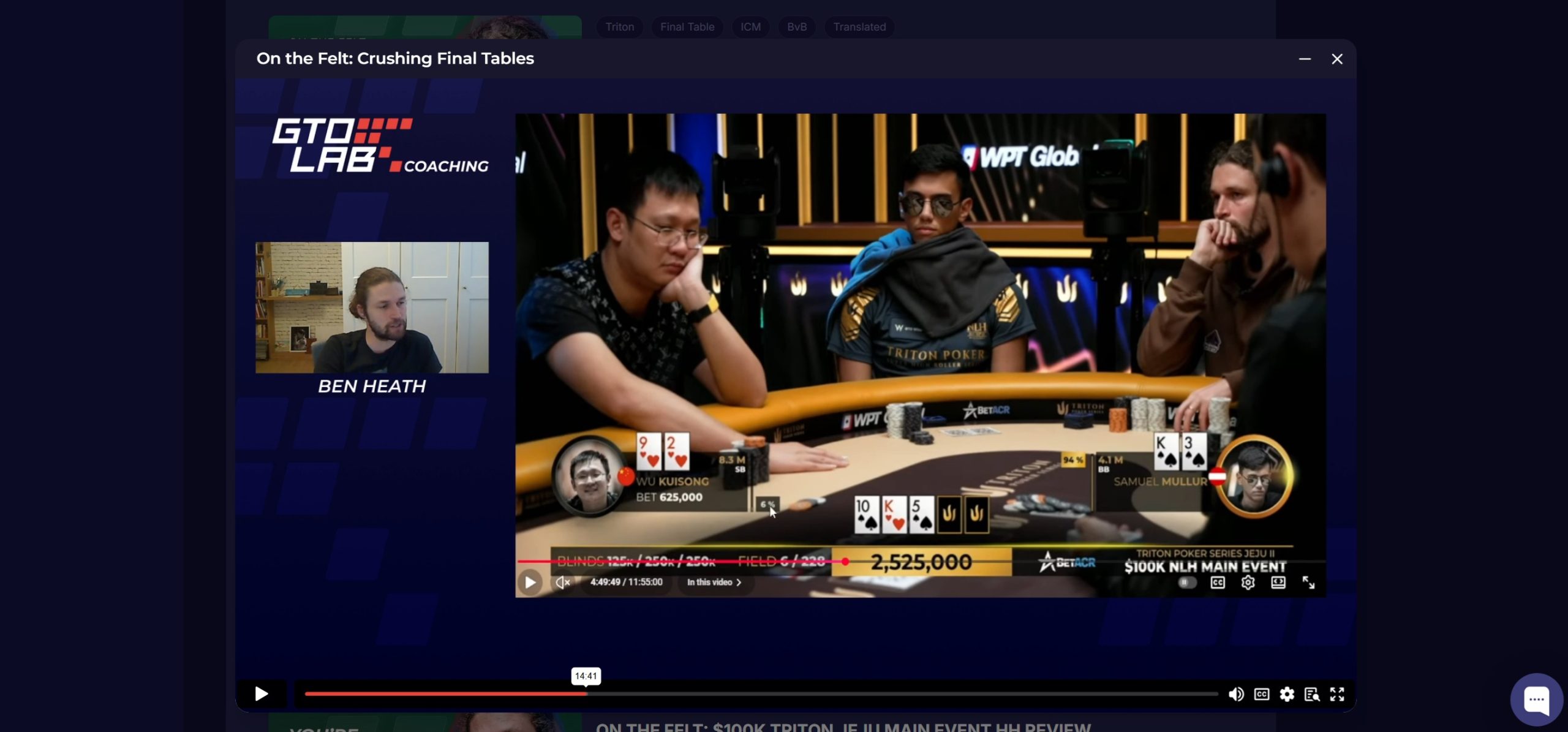
Ben Heath on final table ICM decisions, On the Felt | GTO LAB
Bet sizing shrinks with medium-strength hands. The goal is to generate value without building a pot you’re forced to navigate at elevated ICM risk. Bet-check-bet lines replace the large-turn-barrel approach that works in chip EV.
Check-raising thresholds change under covering pressure. You check-raise less frequently with hands that can’t comfortably get stacks in, and shift more value into check-calling or check-folding lines.
In flat-payout structures like the GGMillion$, postflop ICM is less restrictive. Smaller pay jumps mean you can take more traditional postflop lines without the catastrophic downside of a large-pot loss in a top-heavy structure.
Three environments, three calibrations
Small field, high stakes: Triton
At Triton final tables, you face elite regulars who understand ICM, run solvers on specific configurations, and make precise postflop adjustments. Against a strong opener, Ben Heath recommends shifting toward a maximally polar 3-bet strategy: AA for value, the best suited blockers as bluffs. Mixing in AK or KK as semi-bluffs gives sharp opponents profitable calling ranges. Dylan Linde‘s analysis of the Monte Carlo hands shows a preference for medium sizes even with strong holdings on connected boards polarizing to large sizes in this field gives opponents exact reads on your distribution.
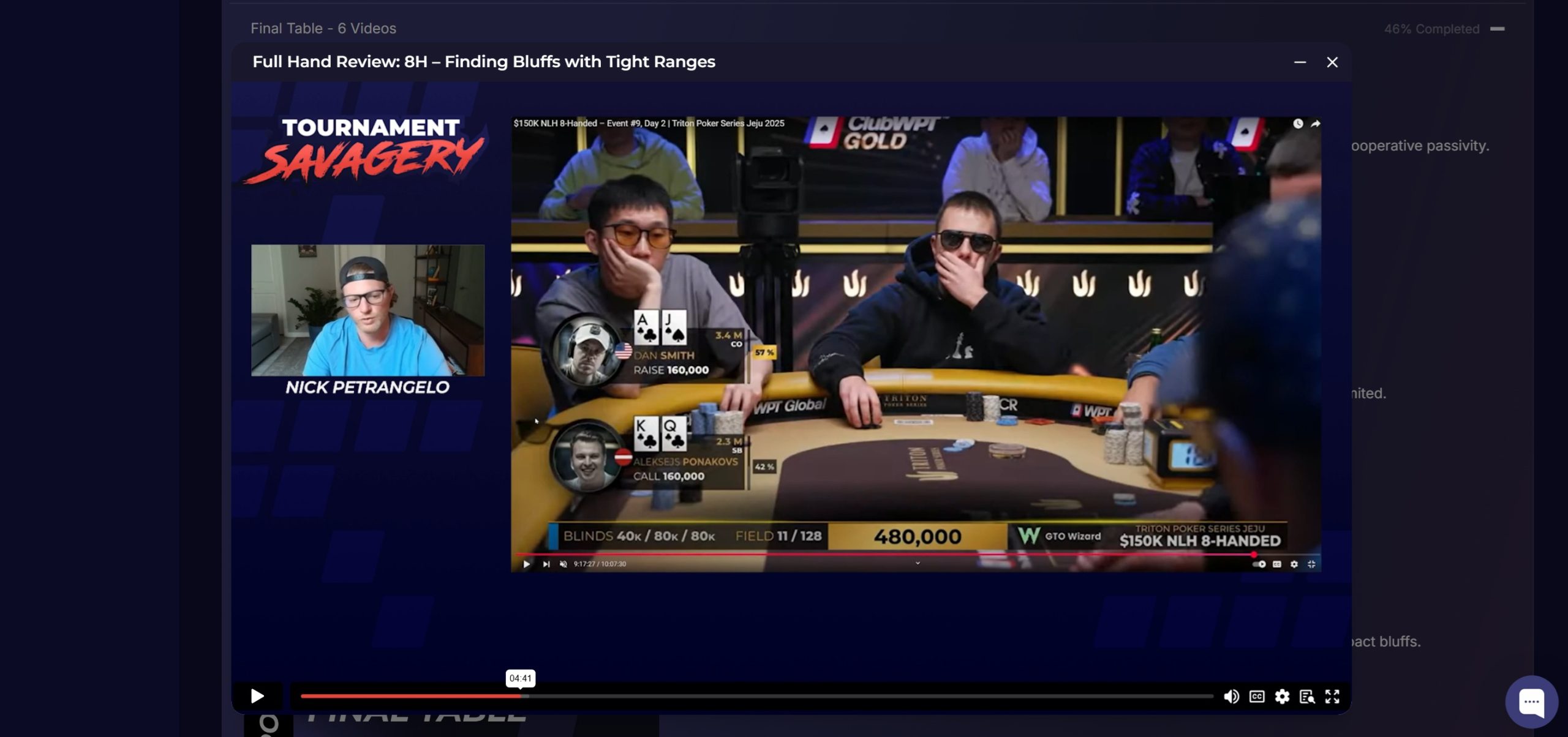 Nick Petrangelo reviewing a Triton final table hand On the Felt | GTO LAB
Large field: WSOP Main Event
The WSOP Main Event final table mixes experienced tournament regulars with amateurs on the run of their lives. The critical adjustment is identifying which opponents respect ICM and which are making emotional, hand-based decisions. Against players who respect 3-bets too much, medium-stack 3-bet frequency can increase. Against players making emotional decisions, value-betting frequencies go up across all streets. The top-heavy structure means the field systematically over-ladders, sacrificing first-placequity for small pay-jump security that doesn’t justify the chip cost.
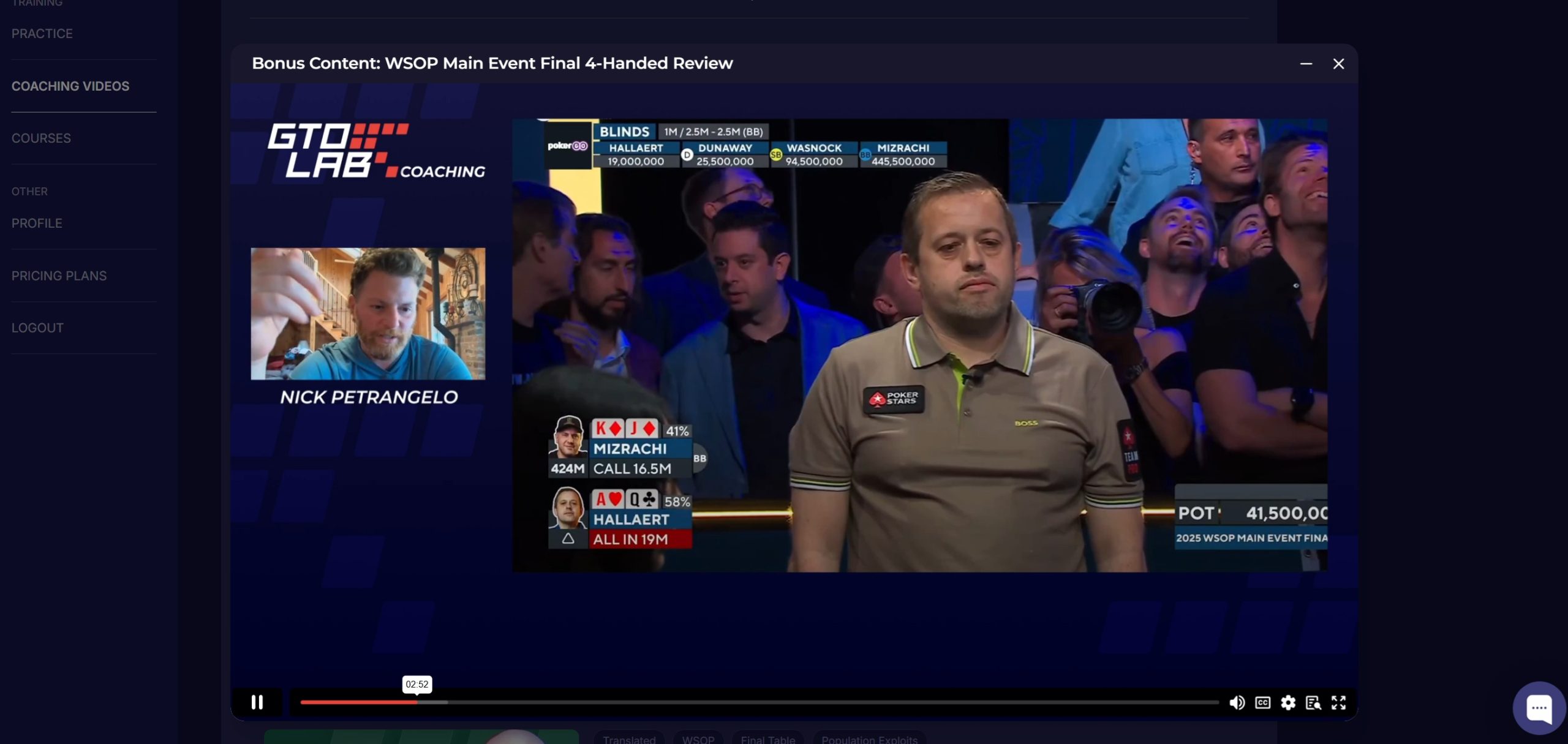
Nick Petrangelo reviewing WSOP Main Event final table hands On the Felt | GTO LAB
Online: GGMillion$
The GGMillion$ flat structure actually increases ICM pressure at every individual pay jump because the jumps are close together and ladder frequently. This means survival has more value per spot than in a top-heavy format. Play tighter near pay jumps, defend your stack, and resist marginal gambles that would be fine in a top-heavy structure. Online antes are also smaller per player than a live BB ante, especially 3-5 handed, ning less dead money in the middle and tighter short stack shove ranges compared to an equivalent live final table. The key skill the GGMillion$ rewards disproportionately: knowing when to be a spectator, allowing big stack clashes to eliminate players while you collect free pay-jump equity you ver risked chips to obtain.
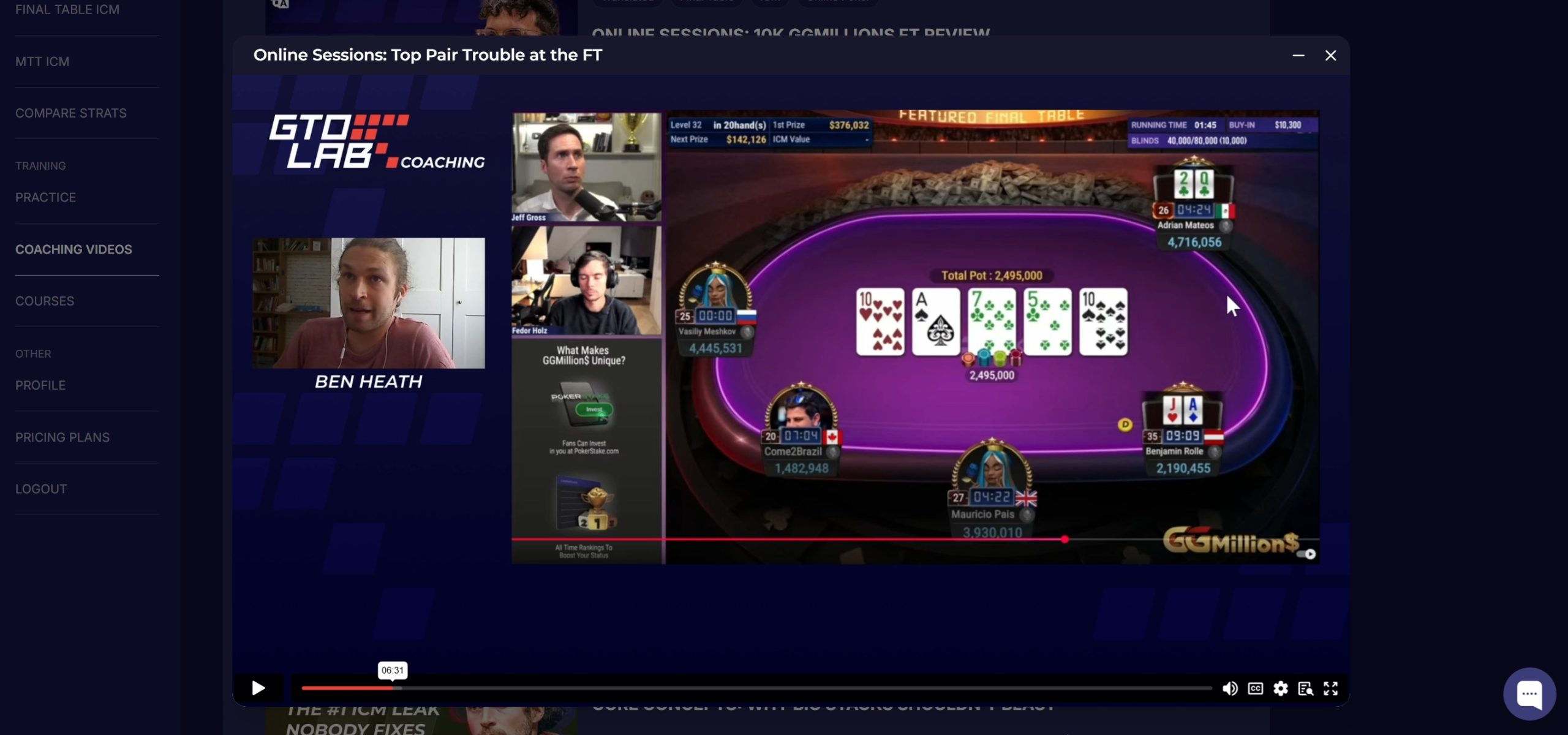
Ben Heath on high-stakes final table dynamics, GGMillion$ | GTO LAB
The most common final table ICM mistakes (see our guide on Common ICM Mistakes)
Six leaks that cost the most equity
1. Reading ICM pressure from your hand, not the structure
You hold JJ. Instinct says play for stacks. The structure says you’re 4th with three pay jumps available and a chip leader to your left. The structure should win more often than most players allow it to.
2. The pyramid of weak hands as chip leader
Opening far too wide because your stack feels invincible. You accumulate dominated holdings and run into calling ranges that have every board locked. Chip leaders should counterintuitively tighten into covered blinds.
3. Flatting in the 3-bet-or-fold zone
Players with 20–28BB who flat opens create awkward SPRs that produce forced bad calls or ICM-heavy folds. Below 30BB: 3-bet the hands worth playing, fold the rest.
4. Thinking 50% equity is enough to stack off
In chip EV, 50% equity is the break-even point for a flip. Under ICM, it’s not, the risk premium means losing your stack costs more than winning it gains. You need meaningful more than 50% equity to justify stacking off against a covering stack near a pay jump. The exact threshold depends on your specific ICM exposure, but the direction is always the same: your break-even equity is higher than 50% at a final table.
5. Psychological whiplash at pay-jump boundaries
Over-folding into a pay jump, then immediately over-calling once it passes. The ICM landscape didn’t change dramatically, the covering relationships and stack distributions a largely the same. Stay calibrated.
6. Ignoring seat quality entirely
Two players with identical stack sizes at the same final table can face radically different ICM pressure.t ICM exposure depending on where chip leaders and short stacks sit relative to them. Assess seat quality before the first hand, it’s non-optiona
Frequently asked questions
What is final table ICM?
Final table ICM is the application of the Independent Chip Model to final table spots, where pay jumps are largest and the gap between chip EV and real dollar EV is most signicant. It shapes calling ranges, shoving ranges, and even postflop lines at every stage of the final table from 9-handed down to heads-up.
When does 3-bet-or-fold apply at a final table?
Generally when you fall below 28–30 big blinds and flatting doesn’t have clearly positive expectation due to cover or stack geometry. Above 30BB, flatting is viable depending on position and opponent tendencies. Below 20BB, shove-or-fold replaces 3-bet-or-fold as the primary decision regime.
How much does payout structure change preflop ranges?
Significantly. In a flat structure like the GGMillion$, shove and call ranges expand relative to a top-heavy WSOP structure. The difference in bubble factors between these structures with identical stack distributions can be 3–4 percentage points on risk premium. Use HRC or ICMIZER to run your specific payout before a major final table.
Should I flat strong hands against chip leaders?
Often yes, from the correct stack depth. Flatting KK in certain chip-leader-vs-chip-leader configurations creates better implied odds than 3-betting into a polarized response. If the chip leader plays close to GTO postflop, flatting maintains range connectivity. If they’re loose or predictably aggressive, 3-betting for value is generally correct.
How do I apply FGS at a final table?
FGS accounts for the value of being alive to see future hands, most critically for short stacks. In practical terms: your shove ranges should be slightly tighter than pure ICsuggests in some configurations, because the value of surviving to see a chip-leader clash exceeds the marginal EV of the shove. The Monster Stack data shows the gap between ICM and FGS5 can be 14+ percentage points on the same shove, it’s worth running your ecific configuration before a major final table.
Final table ICM: key takeaways
Assess the macro frame before you look at your hand: payout structure, stack geometry, seat quality, and ante format all precede hand selection
Flat payouts (GGMillion$) create higher ICM pressure at each pay jump survival matters more per spot. Top-heavy payouts (WSOP Monster Stack) reward accumulation over laddering
The chip leader’s range is often weaker than it looks the “pyramid of weak hands” is exploitable by prepared mid-stack defenders
3-bet-or-fold applies from roughly 28–30BB down. Flatting in this zone creates awkward SPRs under ICM pressure with no clean resolution
Short stacks should use FGS-adjusted ranges not pure ICM for shove/fold decisions when chip-leader clashes are imminent
Postflop stack-off thresholds rise significantly under ICM, even witequity advantages that would clearly justify commitment in chip EV
Seat quality covering relationships, position relative to chip leaders and short stacks shapes your ICM exposure before a single card is dealt
Ready to apply this?

26 sessions. Preflop and postflop strategy across all stack depths, ICM adjustments for bubble and final table situations, exploitative lines against the mistakes real players make at every stage. Use code NICK26 for $26 off.
ICM Strategy — Complete Guide
→ ICM vs Chip EV
→ Final Table ICM (you are here)
→ ICM on the Bubble
→ Short Stack ICM (coming soon)
→ Big Stack ICM (coming soon)
→ ICM in PKOs (coming soon)
→ Postflop ICM (coming soon)
→ Common ICM Mistakes
→ How to Study ICM (coming soon)