



What you’ll learn
- Why the bubble warps every decision at the table — and how to exploit it
- How bubble ICM pressure differs by stack size — and who is actually most constrained
- How the bubble factor works and what it actually tells you in real time
- The blocker hand principle: why A-9o beats 9-8s on the bubble
- The reshove triangle: which pairs to shove and which to ditch
- How to calculate your bluff-to-value ratio under ICM in under 30 seconds
- Postflop adjustments most players completely miss on the bubble
- How GTO LAB’s Compare Strats feature shows you bubble vs chip EV side by side
The bubble is where most tournaments are actually decided. Bubble ICM — the application of the Independent Chip Model to money bubble spots — is the single most important framework for navigating this phase correctly. Not at the final table — on the bubble. The decisions made when 151 players are left and 150 get paid, when everyone at your table knows exactly what’s at stake, are the ones that separate players who consistently run deep from players who consistently cash small and go home.
ICM on the bubble is also one of the most misunderstood phases in tournament poker. Players either treat it like a cash game — calling off stacks they shouldn’t, bluffing into players with nothing to lose — or they lock up completely, folding themselves into mediocrity while the chip leaders print money around them.
This guide pulls directly from GTO LAB’s coaching content: Tournament Savagery, the 26-Day Training Plan, and over 200 hours of live hand analysis in the coaching video library. If you haven’t read what ICM is and how chip EV and ICM diverge, start there first.
The ICM bubble factor: what the platform shows you
Before anything else, let’s talk about what ICM pressure actually looks like at the bubble — not in theory, but in the GTO LAB platform itself.
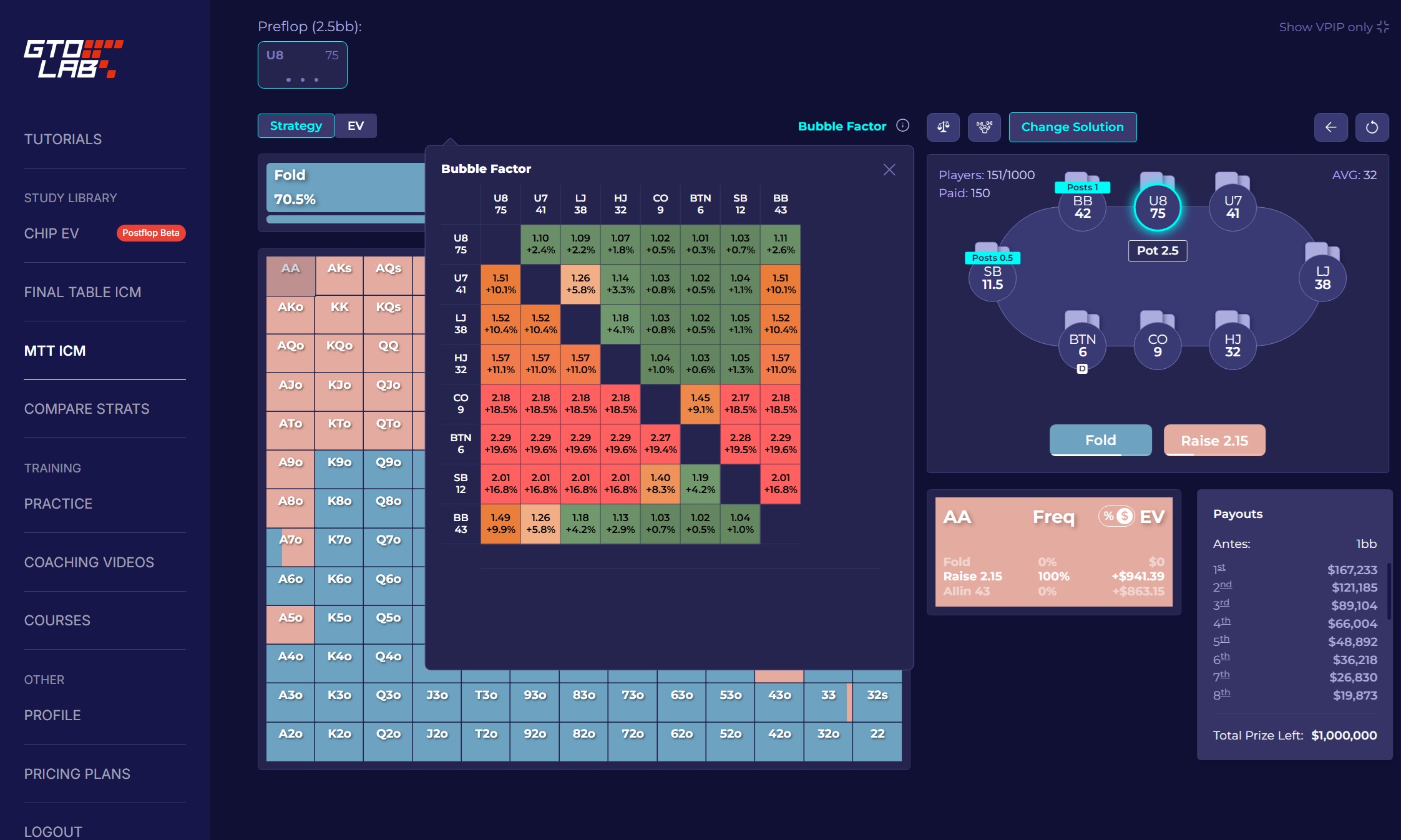
What you’re looking at is the Bubble Factor matrix inside GTO LAB’s MTT ICM solver. The scenario: 151 players left, 150 get paid. U8 sits with 75bb, the average stack is 32bb, and SB is the short stack with just 11.5bb.
Look at the CO row. CO has 9bb and faces U8 with 75bb. The bubble factor reads 2.18 — meaning losing chips costs more than twice what gaining chips is worth. That’s an enormous constraint. Now look at BTN with 6bb against U8: 2.29, nearly +19.6% risk premium. These players are deeply ICM-constrained.
But look at the SB row — the 11.5bb short stack. Against most positions, risk premiums are 1.40–2.01 with percentages mostly in the 8–17% range. Lower than the medium stacks. This confirms one of the most counterintuitive truths about bubble play: short stacks feel the ICM pressure less, not more. They’re closer to bust anyway. The players with the most to lose are the mid-stack players who have real equity to protect.
Short stacks on the bubble: closer to chip EV than you think
Understanding this changes how you play against them too. From GTO LAB’s coaching: when there’s a 15bb short stack at the table on the bubble, suited connectors like 9-8s and 7-8s lose most of their value as opening hands — because you’re not going to see a flop. What you actually want is a blocker hand. A-9 offsuit is better than 9-8 suited in many bubble configurations, because the Ace blocks the exact hands that want to reshove over you.
The blocker principle
Suited connectors need playability — they need to hit boards and realize equity. On the bubble with a short stack behind, playability is nearly worthless. You’re facing jam or fold preflop. What matters is the Ace: it blocks the hands that want to reshove over you, and it gives you clean fold equity when you open. A-9o beats 9-8s. A-4o beats 7-6s. This is one of the first lessons in Tournament Savagery’s Near the Bubble section.
Tournament Savagery: what the bubble lessons actually teach
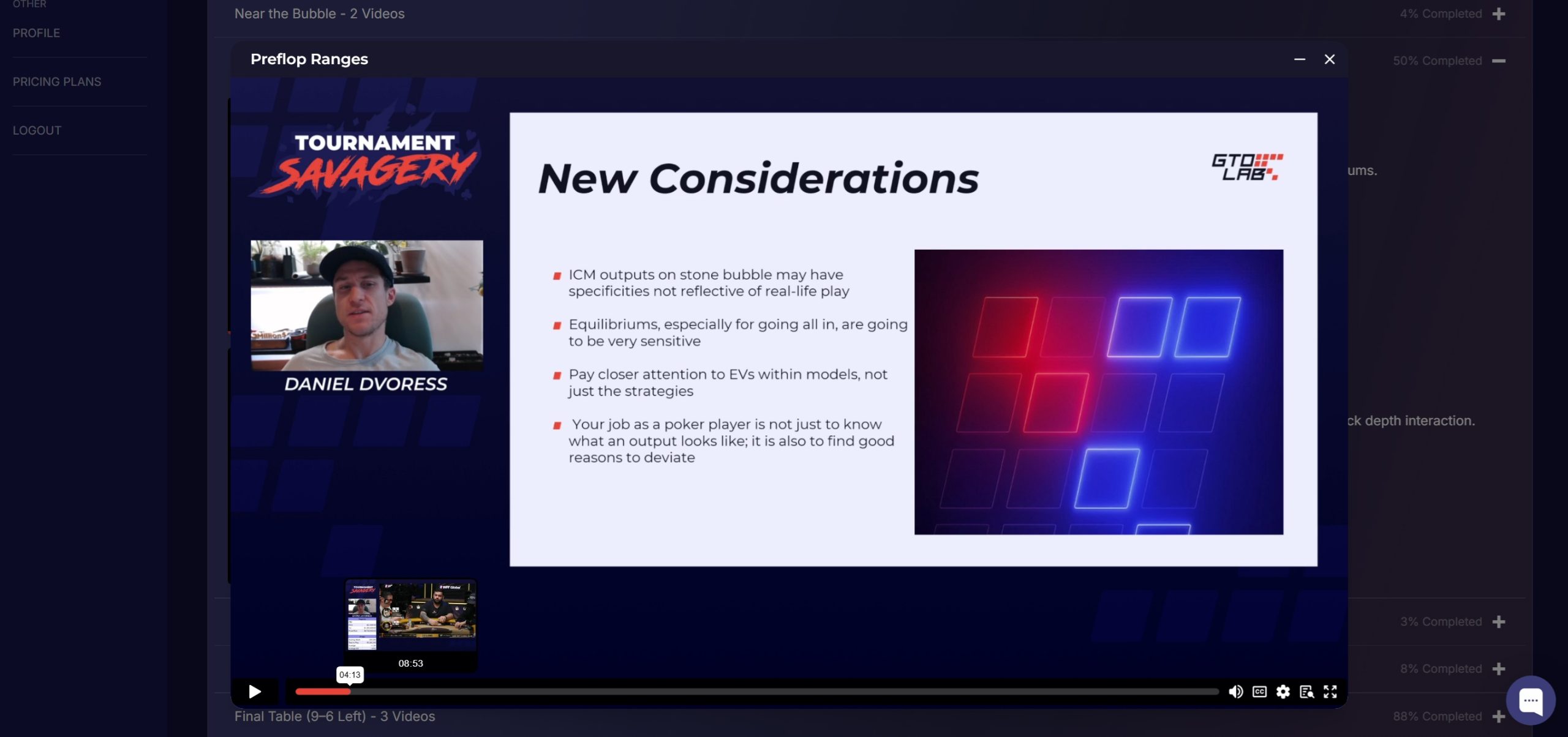 Daniel Dvoress teaching Near the Bubble preflop ranges in Tournament Savagery course” style=”width:100%;border-radius:8px;display:block;” />
Tournament Savagery breaks the bubble into four distinct phases: Near the Bubble (2 lessons), The Bubble (2 lessons), Post Bubble (2 lessons), and Near the Final Table (2 lessons). Each one has different strategic requirements — and getting them confused is a costly mistake most players make without realising it.
The Near the Bubble lesson with Daniel Dvoress covers four key new considerations that apply once the bubble is in sight:
| Consideration | What it means in practice |
|---|---|
| ICM outputs may not reflect real play | Stone bubble sims are sensitive — use them as a guide, not gospel |
| All-in equilibria are very sensitive | Stack depths and table dynamics shift the solver’s output significantly |
| Pay closer attention to EVs, not just strategies | The EV difference between actions tells you how much each mistake costs |
| Find good reasons to deviate | Your job is not just to know the output — it’s to find when deviating is +EV |
That last point is the one most coaching content ignores. The solver gives you the equilibrium. Daniel’s lesson teaches you when and why to deviate from it — which is where real edge lives, particularly against player pools that are emotionally responding to the bubble rather than mathematically responding to it.
Compare Strats: seeing bubble vs chip EV side by side
One of the most powerful tools inside GTO LAB is Compare Strats — the ability to load any scenario in chip EV alongside the same scenario under MTT ICM and see exactly what changes. This is how you build genuine ICM instincts rather than memorizing outputs.
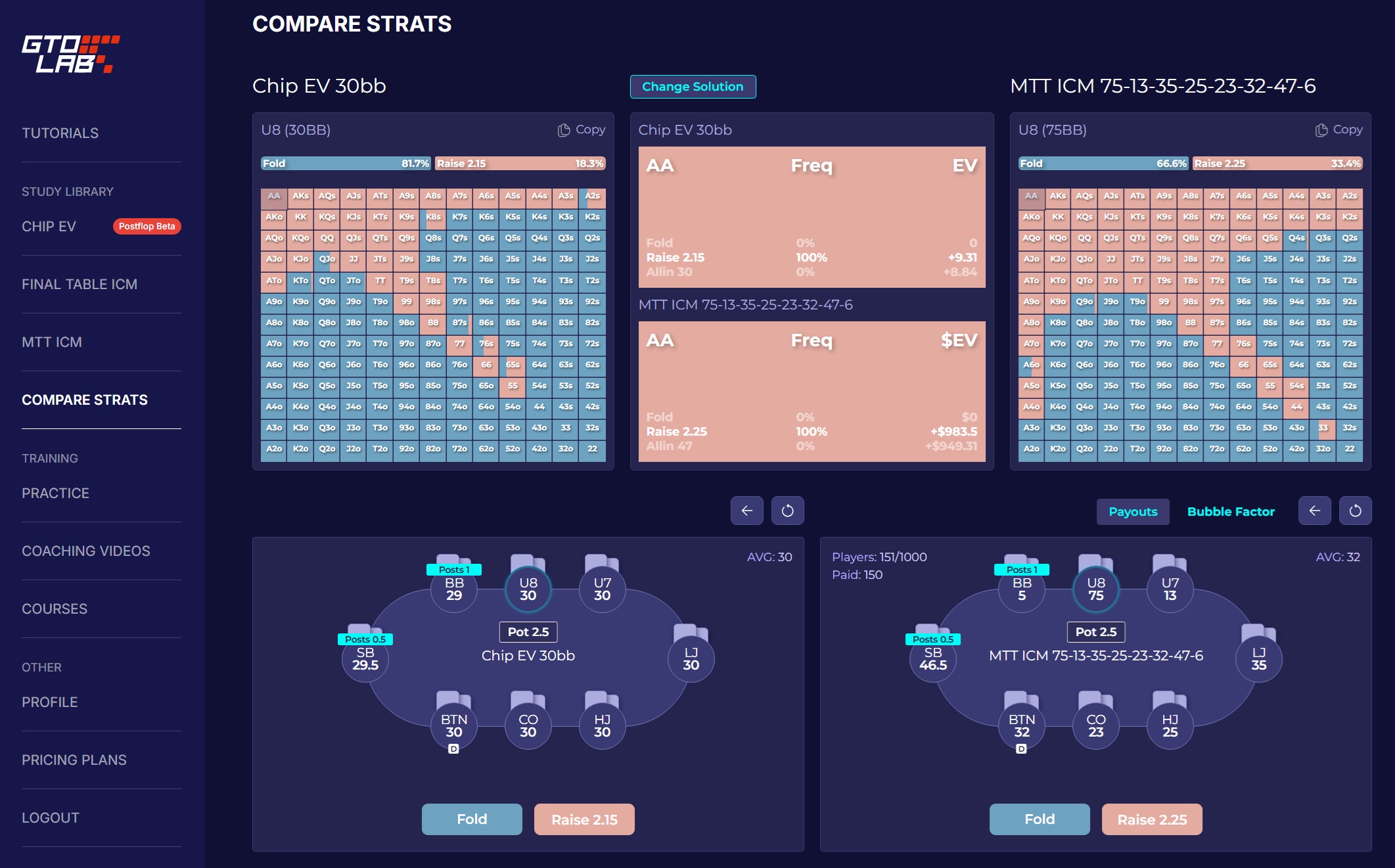
Look at U8’s opening range on the left (chip EV, 30bb, everyone equal) versus the right (MTT ICM, bubble, 151 left). The overall fold frequency goes from 81.7% to 66.6% — but that’s because U8 has 75bb in the ICM scenario, not 30bb. The key is what happens to the raise sizing and which hands change. In chip EV, AA raises 2.15x 100% for +$9.31 EV. Under ICM, AA still raises 100% but the raise is now 2.25x for +$983.50 — the real dollar value explodes when there’s a pay jump on the line.
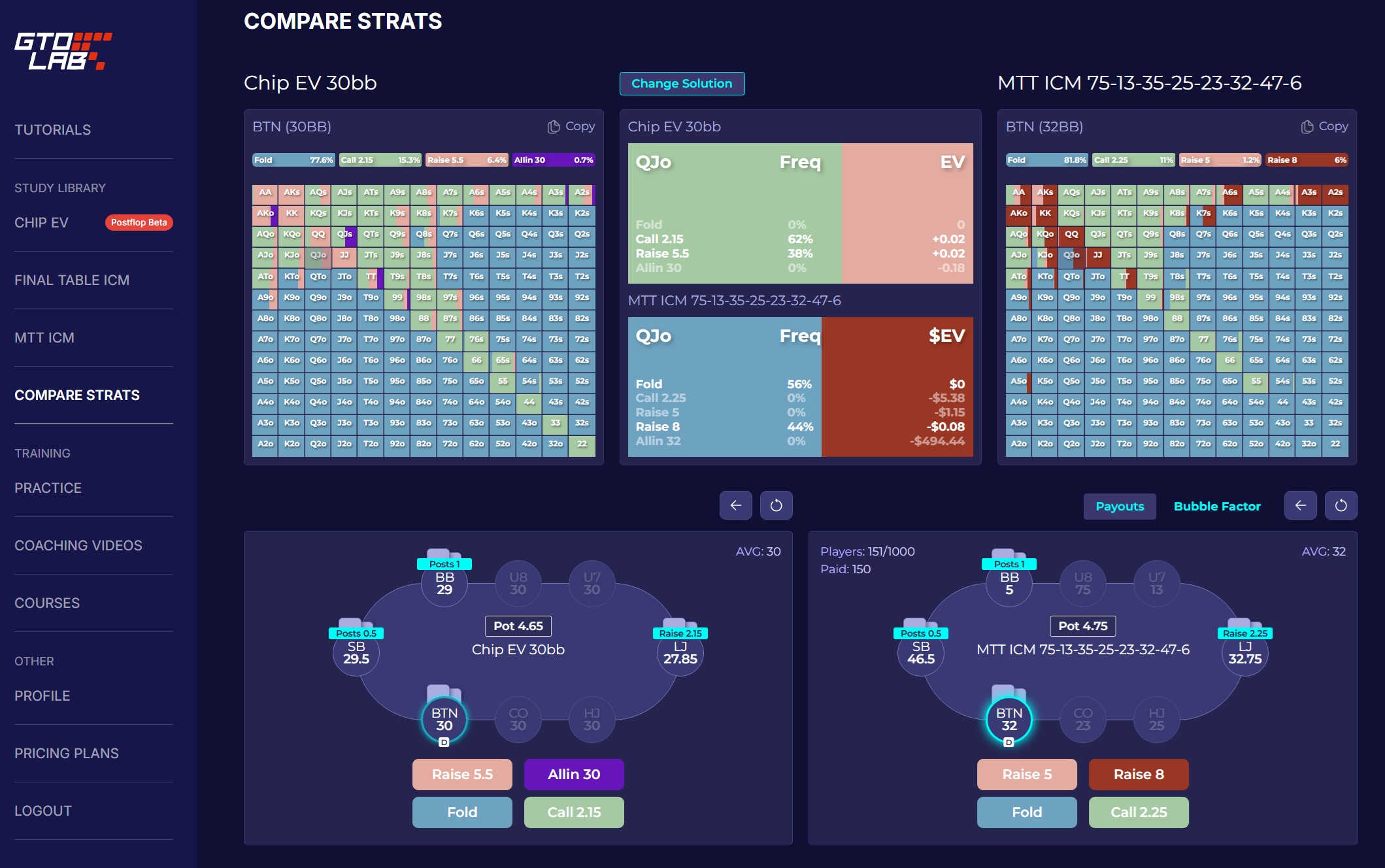
The QJo comparison is striking. In chip EV it’s a mix of call (62%) and raise (38%). Under MTT ICM bubble conditions it becomes 56% fold, with the call and raise both losing significant $EV. This is why bubble play feels different — hands that look fine in chip EV are losing plays under ICM, and the only way to see it clearly is to compare them directly. That’s exactly what Compare Strats lets you do.
What GTO LAB members use Compare Strats for
Load any preflop spot — BTN vs BB, SB vs BTN, any position — in chip EV alongside the bubble scenario. See immediately which hands tighten, which stay the same, and exactly how much EV each action costs under ICM pressure. This is the tool that turns abstract ICM theory into concrete range adjustments you can actually apply at the table.
Combined with Tournament Savagery’s dedicated bubble preflop lessons, members don’t just see the ranges — they understand why they change.
The reshove triangle: which pairs to shove and which to ditch
One of the sharpest preflop insights from GTO LAB’s bubble content: when you’re considering reshoving on the bubble, you don’t just shove your strongest hands — you shove hands that fold out something better than them.
The heuristic from Tournament Pressure with Nick Petrangelo: use pairs that fold out 1 or 2 better pairs. Facing a BTN open on the bubble, 44/55/66 reshove profitably because they fold out 55/66/77/88. But 22/33 don’t fold anything relevant — the hands that will call them are also ahead of them, and the hands that would fold don’t need to be folded out. Their blockers accomplish nothing.
The pair selection rule
Shove: 44, 55, 66 — they fold out 77/88/99 from opponents who open wide but won’t call off without a stronger pair
Don’t shove: 22, 33 — nothing relevant folds. Hands that beat you call, hands that you beat were already folding
If you know your opponent is opening 77+ and won’t call off, shoving 55 and 66 becomes even more profitable — you’re folding out the exact pairs that have you crushed. This is opponent-dependent, not just hand-strength-dependent.
This same framework applies when you’re thinking about calling a bubble shove. From Nick’s Tournament Pressure series: when expanding your calling range under ICM, expand into domination — not into flips. You don’t want to call because opponents are shoving more hands you flip against. Those are the hands you’re worried about. You want hands that crush the bluff-heavy or pair-heavy shove range.
“When you’re thinking about expanding your calling range in these ICM scenarios, you really want to expand it to deal with hands that you dominate. You don’t really want to run into a scenario where you’re flipping for a lot against a wide portion of their range.”
— Nick Petrangelo, Tournament Pressure series, GTO LAB
Bluff-to-value ratio under ICM: the 30-second table calculation
Tournament Savagery introduces a concept from Thomas Boivin that doesn’t get discussed anywhere else: the preflop bluff-to-value ratio (BTVR) — a practical framework for balancing your 3-bet range on the bubble in real time.
In chip EV, the ratio is roughly 0.7–1 bluff combo per value combo in a BB polar 3-bet spot. With 40 value combos (JJ+ and AKo/AKs), you’re looking at 30–40 bluff combos. Under ICM on the bubble, that ratio compresses — your value range tightens because your own risk premium increases, and your bluffing frequency drops accordingly.
Here’s the clarification that most players get wrong: your own risk premium determines your value range. Your opponent’s risk premium determines how many bluffs you can include. These are not the same thing. The chip leader on the bubble has a low personal risk premium, so their value range stays wide — but they can bluff heavily because their opponents’ risk premiums are high and those opponents will fold too much.
The common misconception
“I can’t bluff too much because I’m covered here” — wrong. Being covered raises your value threshold slightly, but it doesn’t determine your bluff frequency. “I’m the chip leader so I can bluff a ton” — also incomplete. Your bluff frequency depends on your opponents’ risk premiums, not your own stack size. Both pieces of information matter, but for different parts of the calculation.
Bubble Trouble in practice: reading compressed short stack ranges
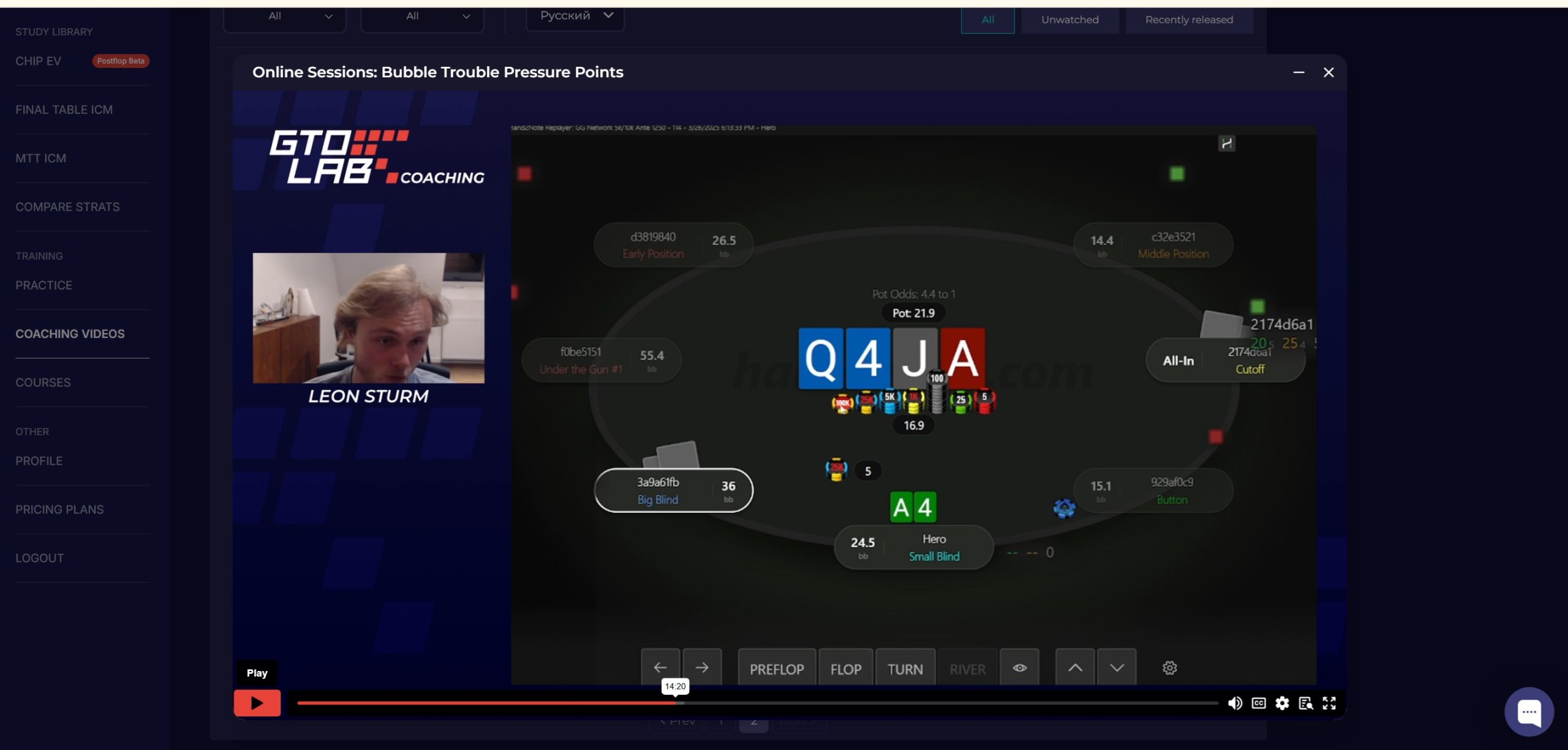 Leon Sturm coaching video: Online Sessions Bubble Trouble Pressure Points on GTO LAB” style=”width:100%;border-radius:8px;display:block;” />
One of the most instructive bubble videos in the GTO LAB library is Leon Sturm‘s Bubble Trouble Pressure Points — a real-time review of $25 GG Network tournament hands at the money bubble. The hand shown: A4 in the SB with 24.5bb, facing a cutoff all-in on a Q4JA board with pot odds of 4.4 to 1.
What makes this session valuable isn’t just the hand — it’s the systematic approach to reading short stack flat ranges. When a short stack flats preflop on the bubble rather than shoving, their range becomes very specific:
- Suited connectors: 98s, J9s — hands with playability they don’t want to jam
- Broadways they’re slow-playing: QT, KT, JTo
- Occasional Kx hands — but most Kx would have jammed preflop
- Almost never: top pairs, strong Ax, overpairs — those should have gone in preflop
Once you know their range has almost no Kx and very few top pairs, you can make postflop decisions that look impossible to outside observers. When the board runs out with a King, a player who has correctly narrowed that range knows they’re not facing a top pair — they can apply pressure or call bluffs with information most players never access.
Another key insight from the session: the min-raise often outperforms the open-jam at 20-25bb depth on the bubble. At that stack size, an open-jam gives opponents clean odds to call. A min-raise forces a worse price on reshovers, lets you fold to 3-bets more precisely, and importantly — when players are playing scared on the bubble, it induces them to jam back with hands they would have folded to a bigger open. You trap more often, and the times you fold are cleaner.
Bubble analysis at the WSOP Main Event level
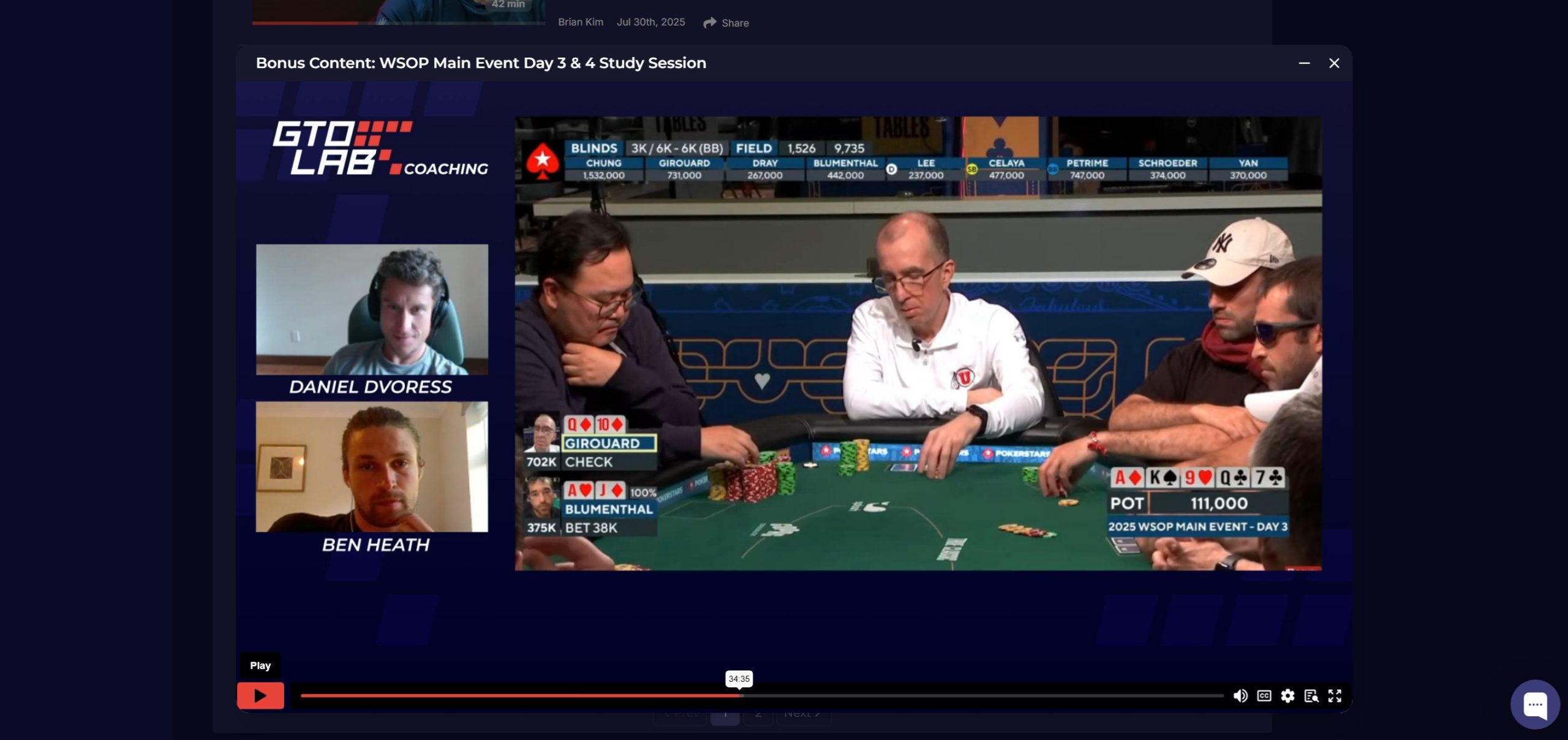 Daniel Dvoress and Ben Heath reviewing WSOP Main Event Day 3 bubble hands on GTO LAB” style=”width:100%;border-radius:8px;display:block;” />
The GTO LAB bonus content series includes Daniel Dvoress and Ben Heath reviewing 2025 WSOP Main Event hands as they happen — including bubble day. With 1,526 players remaining from 9,735 entrants, the bubble spots they analyze are exactly the type most players face once or twice a year in their biggest tournaments.
What separates this content from standard coaching videos: both coaches are GTO LAB course instructors who built the solver frameworks in Tournament Savagery. When they debate a postflop line or a preflop shove, they’re drawing on the same theoretical architecture members use in practice — not just intuition. The gap between “what feels right” and “what the math says” is visible in real time.
Postflop bubble ICM: the adjustments most players completely miss
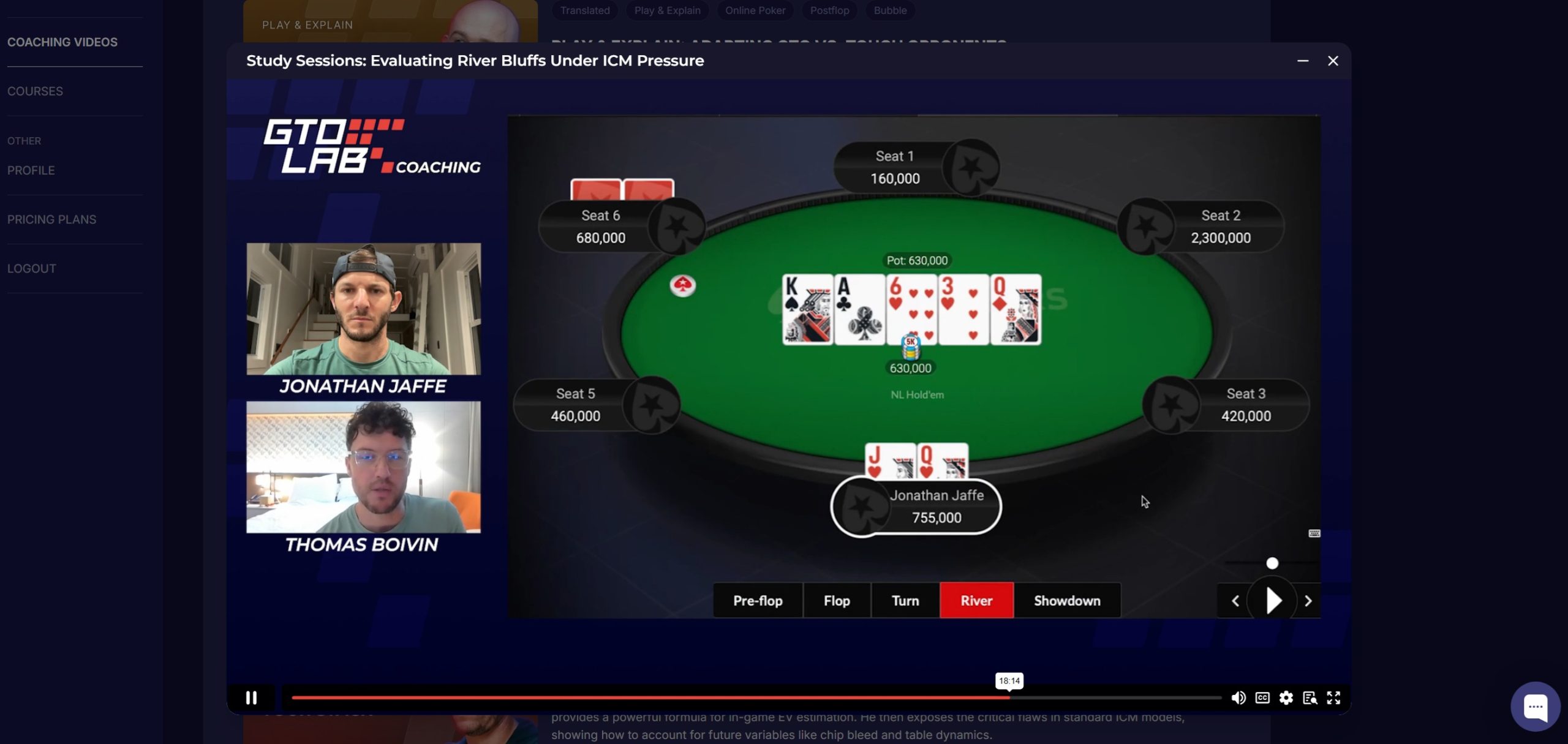 Jonathan Jaffe and Thomas Boivin reviewing river bluffs under ICM pressure on GTO LAB” style=”width:100%;border-radius:8px;display:block;” />
Preflop ICM adjustments get all the attention. But the bubble changes postflop strategy in ways most players never study — and those adjustments are where a huge amount of EV leaks.
IP check frequency increases sharply. In-position players check back significantly more often on the bubble — they’re warier of building pots when ICM pressure is elevated. This creates a structural opportunity OOP: donk betting becomes more profitable, because your opponent’s checking range is now wider and more capped than it would be in chip EV. When IP players check more, your donk bets apply pressure to hands that would have bet in chip EV but are now checking to manage ICM exposure.
Off-suit combinations are your primary bluff targets. From GTO LAB’s Play & Explain series covering a WSOP $1K bubble: the main targets for postflop bluffs are off-suit hands. They have a single card of the relevant suit, they’re hardest to fold profitably, and they pack most calling ranges. When you’re building a bluffing range on the bubble, think first about which off-suit hands your opponent needs to fold — those are the combos that give you fold equity without risking running into nutted hands.
Calling standards rise by 4-5% in equity terms. In chip EV, you need roughly 33% equity to break even on a call. On the bubble, that threshold rises to around 37-38% once you account for the bubble factor and stack preservation premium. Calls that look fine in chip EV often become losing plays under ICM — and understanding which ones is what separates solid grinders from genuinely dangerous tournament players.
Exploiting fear on the bubble: what Thomas Boivin finds
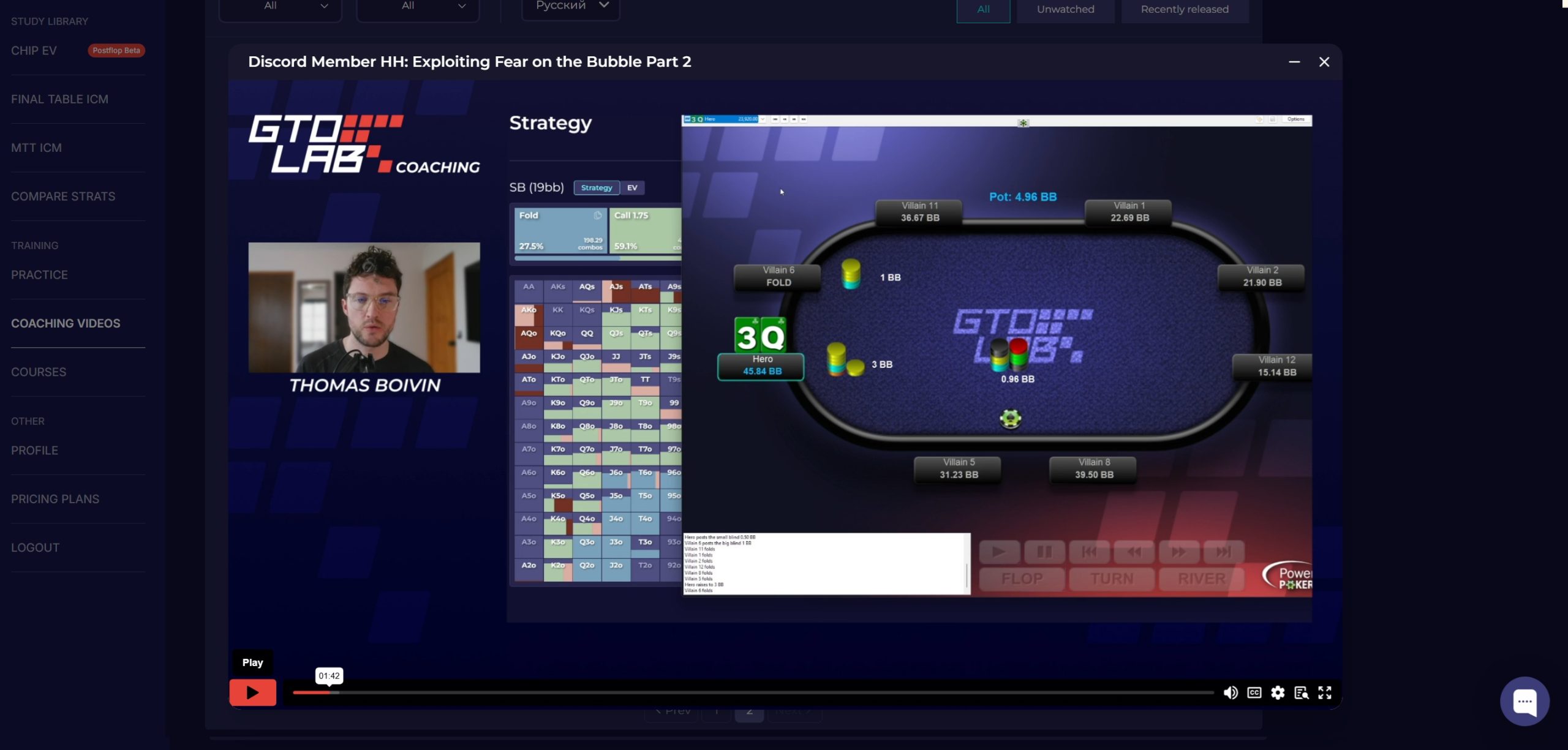 Thomas Boivin reviewing Discord member hand on exploiting fear on the bubble in GTO LAB” style=”width:100%;border-radius:8px;display:block;” />
Thomas Boivin’s Discord HH review series covers bubble spots submitted by actual GTO LAB members — real hands from real tournaments, analyzed with solver data. The session on Exploiting Fear on the Bubble is one of the most practically dense videos in the library.
The core insight: taking the chip lead on or near the bubble creates a compounding EV effect. Winning a pot that makes you the chip leader doesn’t just add chips — it changes the table dynamic for the next several hands. “Those next few hands actually have great EV for us, because that’s the bubble.” Everyone else is scared. You’re free. The EV of each individual hand in that sequence is higher than any single spot in isolation — and that compounding effect is something solver outputs alone don’t show you.
Thomas also covers a key postflop adjustment that appears repeatedly in bubble coaching: when facing a polar 3-bet on the bubble, you often need to be “sticky” — calling with hands that look impossible to defend with in chip EV. A super-polar 3-bet range has very few hands between the premiums and the complete bluffs. Your pot odds are excellent against a range that’s mostly air. Hands like J2s and T8o have the odds to call, and most players over-fold here at exactly the moment they shouldn’t.
The emotional bubble vs the mathematical bubble
One of the clearest lessons from GTO LAB’s Post Bubble Clarity content: the emotional pressure players feel at the bubble often has almost no mathematical basis. In large-field tournaments with 150+ players left, risk premiums for average stacks are meaningful but not enormous — roughly in the range that warrants moderate adjustments, not the kind of lock-up and fold mentality most recreational players display.
Players stall. They fold marginal spots they shouldn’t fold. They tighten up on hands where tightening up costs them chips. The emotional deep run feeling is real — but it’s exploitable by the players at the table who understand the math. Their tightness is giving you free chips. Their fear is your profit.
The correct adjustment: adapt to their emotional tightness, not your own emotional state. If players at your table are folding too much because they want to cash, exploit that. Open wider. Squeeze more. Put them to decisions they don’t want to make. The mathematical ICM constraint on your own range is real but modest — the behavioral exploit from their over-adjustment is much larger.
Post-bubble: don’t overcorrect back
Tournament Savagery has two Post Bubble lessons for exactly this reason. Once the bubble breaks, risk premiums drop back. Short stacks return toward chip EV. Average stacks relax. The next major inflection point where ICM pressure meaningfully rises again is around the final three tables. Until then: open up, accumulate chips, and build the stack you need to be dangerous at the final table.
Everything inside Tournament Savagery’s bubble section
Tournament Savagery is structured so each phase of a tournament gets its own dedicated preflop lessons — and the bubble phase is treated as the critical inflection point it actually is. Here’s exactly what’s covered:
| Section | Lessons | What you learn |
|---|---|---|
| Near the Bubble | 2 videos | New ICM considerations, blocker principle, EV sensitivity on stone bubble |
| The Bubble | 2 videos | Direct bubble preflop ranges, reshove construction, stack distribution sims |
| Post Bubble | 2 videos | When to open up, risk premium reset, stack building toward the FT |
| BvB under ICM | 3 videos | Blind vs blind pressure at every ICM stage including the bubble |
| FT Postflop | 6 videos | Postflop ICM adjustments that extend directly from bubble principles |
The 26-Day Training Plan complements this with structured daily practice. Days 8 and 9 cover ICM fundamentals. Days 10 and 11 move to final table ICM. Each lesson comes with practice hands — not just video explanations, but active repetition with solver feedback. The preceding days (deep stack cEV through sub-25bb inequal stacks) build the range-reading fluency that makes ICM adjustments feel natural rather than forced. By the ICM days, you’re not learning a new game. You’re calibrating a game you already understand.
Bubble ICM: frequently asked questions
What is bubble ICM in poker?
Bubble ICM refers to how the Independent Chip Model changes decision-making at the money bubble of a tournament. When a pay jump is imminent, chips lost cost significantly more than chips gained — creating the risk premium that tightens calling ranges, rewards aggressive play with fold equity, and makes the bubble one of the highest-EV phases of the tournament for players who understand it.
How does the bubble change preflop ranges?
The bubble tightens calling ranges — you need more equity to call off your stack than in chip EV, typically raising the break-even threshold from 33% to around 37-38%. But aggressive plays with fold equity become more profitable, not less, because opponents are over-folding. Hand selection also shifts: suited connectors lose value when short stacks are present because you won’t see a flop. Blocker hands like A-9o become more valuable than 9-8s.
What is the bubble factor and how do I use it?
The bubble factor measures how much more it costs to lose chips versus how much you gain by winning them in a specific all-in matchup. A bubble factor of 2.0 means losing the pot hurts twice as much as winning it helps. GTO LAB’s platform displays this matrix for every position at the table, letting you see instantly which matchups are most ICM-sensitive.
Is it correct to open-jam or min-raise at 20-25bb on the bubble?
At 20-25bb, the min-raise frequently outperforms the open-jam on the bubble. The min-raise gives opponents worse odds to reshove, lets you fold more cleanly when 3-bet, and on a scared bubble, often induces folds from hands that would have called an open-jam. With hands like A-9o, the min-raise extracts more value from the bubble pressure than jamming does.
How does postflop play change on the bubble?
In-position players check back more often on the bubble, creating donk betting opportunities OOP. Calling standards rise — you need roughly 37-38% equity instead of 33% to break even on calls. Off-suit combinations become the main bluff targets because they’re hardest to fold profitably. And river bluffs need to account for the ICM cost of getting called — the threshold for a profitable bluff rises near the money.
Bubble ICM: key takeaways
The bubble factor matrix shows you exactly which matchups carry the most ICM weight — use it to calibrate aggression, not just calling ranges
Blocker hands beat playability hands when short stacks are present — A-9o outperforms 9-8s in many bubble configurations
Your risk premium sets your value range. Your opponent’s risk premium sets your bluff frequency. Mixing these up is one of the most common leaks in bubble play
Taking the chip lead near the bubble multiplies the EV of the next several hands — factor that into decisions that put you in the chip lead
The emotional pressure players feel at the bubble is often larger than the mathematical ICM constraint — exploit their fear, don’t share it
Once in the money, risk premiums drop back significantly — open up, accumulate chips, and build toward the final table
ICM Strategy — Complete Guide
→ ICM vs Chip EV
→ Final Table ICM
→ ICM on the Bubble (you are here)
→ Short Stack ICM (coming soon)
→ Big Stack ICM (coming soon)
→ ICM in PKOs (coming soon)
→ Postflop ICM (coming soon)
→ Common ICM Mistakes (coming soon)
→ How to Study ICM (coming soon)