



The ICM vs chip EV distinction is the most consequential gap in tournament poker. Every decision you make near a pay jump, on the bubble, or at a final table is shaped by which model applies — and defaulting to the wrong one costs real money. This article breaks down both frameworks, explains where and why they diverge, and draws on insights from four GTO LAB coaches to show what the ICM vs chip EV gap looks like in practice.
| Chip EV | ICM | |
|---|---|---|
| Unit of value | Chips — linear, equal | Dollar equity — non-linear, asymmetric |
| Win = lose same chips? | ✓ Exactly equal | ✗ Losing always costs more |
| When it applies | Deep in field, no pay jump near | Bubble, final table, pay jumps |
| Solver mode | cEV (chip expected value) | ICM / tournament EV |
| Primary constraint | None — maximize chips freely | Risk premium — extra equity to get at-risk |
Chip EV: the clean but incomplete model
Chip EV treats every chip as having equal, linear value. Win a million chips and you’re a million chips richer. Lose a million and you’re a million poorer. Your share of the chips in play equals your share of the prize pool. This makes chip EV mathematically clean and easy to reason about — and it’s genuinely the right framework when you’re deep in a field with no pay jump close by, when chips accumulated now directly translate to equity.
The problem — and this is exactly where chip EV breaks down and the ICM vs chip EV gap opens up — is that tournaments are not linear. First place pays disproportionately more than chip percentage would imply. The chip leader with 30% of the chips does not expect 30% of the prize pool. There’s a ceiling on chip value that chip EV cannot see.
ICM: where chips become real dollars
The Independent Chip Model converts chip stacks into expected dollar equity by calculating each player’s probability of finishing in each pay position and weighting those probabilities by the payout. The key output is a single principle that Daniel Dvoress covers in depth in Tournament Savagery: losing chips always costs more in dollar equity than winning the same chips gains.
That asymmetry — the heart of the ICM vs chip EV divergence — has a name: the risk premium. It’s what forces players to need more than 50% equity to break even under ICM. A hand that’s a trivial call for chips might be a clear fold in dollar terms, not because you’re wrong about your equity, but because the cost of losing outweighs the gain of winning by a factor chip EV can’t see.
How bubble factors quantify the gap
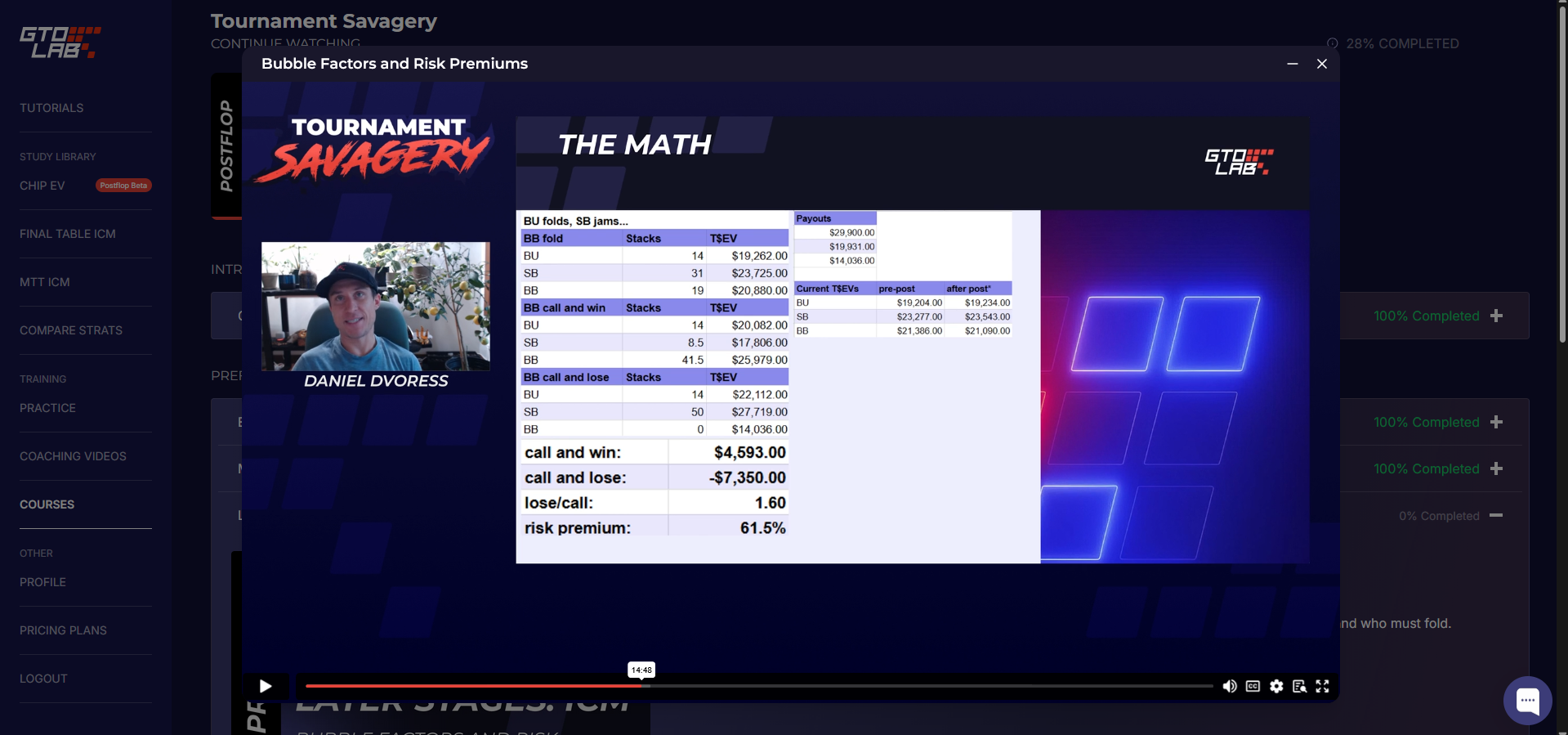
A bubble factor is a number derived for a specific pair of players — always above 1 — that captures exactly how much the asymmetry costs in a particular confrontation. Daniel walks through the mechanics in Tournament Savagery: ICM calculates what your tournament equity becomes if you call and win, and what it becomes if you call and lose. The bubble factor is the absolute equity lost divided by the equity gained.

The conversion from bubble factor to required equity is straightforward: divide the bubble factor by itself plus one. Daniel’s worked example shows a 3-handed spot where the BB faces a SB jam. Equity gained if the call wins: approximately +4,600 in tournament EV. Equity lost if the call loses — elimination in third: approximately -7,350. That gives a bubble factor of 1.60, and 1.60 ÷ 2.60 = 61.5% required equity.
Bubble factor reference
| Bubble Factor | Required Equity | Extra vs chip EV | Typical context |
|---|---|---|---|
| ~1.0 | 50% | +0% | Chip EV territory — deep field |
| 1.2 | 54.5% | +4.5% | Light ICM — mid-late stage |
| 1.4 | 58.3% | +8.3% | Moderate — approaching bubble |
| 1.6 | 61.5% | +11.5% | High ICM — direct bubble, shorthanded FT |
| 2.0+ | 66.7%+ | +16.7%+ | Extreme — bubble with massive stack disparity |
Four ways ICM vs chip EV plays out differently by stack
Understanding the framework is one thing. Understanding how it reshapes strategy for each stack type is where the real edge lives. Here is what four GTO LAB coaches collectively emphasise about each stack’s relationship with the ICM vs chip EV gap.
Big stacks: the cooperation you didn’t expect
The most counterintuitive ICM lesson for big stacks is what Ben Heath calls the cooperative dynamic. In a GTO LAB session analysing two big-stack players deep at a final table, Ben identifies the core constraint: even when you cover the other large stack by a significant margin, building a massive pot risks destroying the combined EV of both stacks — with the surplus flowing to the shorter stacks who survive.
As Ben explains it: when two big stacks are deep against each other, playing a large pot where one gets eliminated leaves the winner with a massive stack and eliminates the loser — but the remaining players gain free equity from the destruction. That lost equity comes from you and your opponent. Chip EV doesn’t see this at all. The result is that big stacks are incentivised toward smaller sizing and lower-frequency aggression against each other — not because they’re afraid to fight, but because the EV of escalating is negative for both.
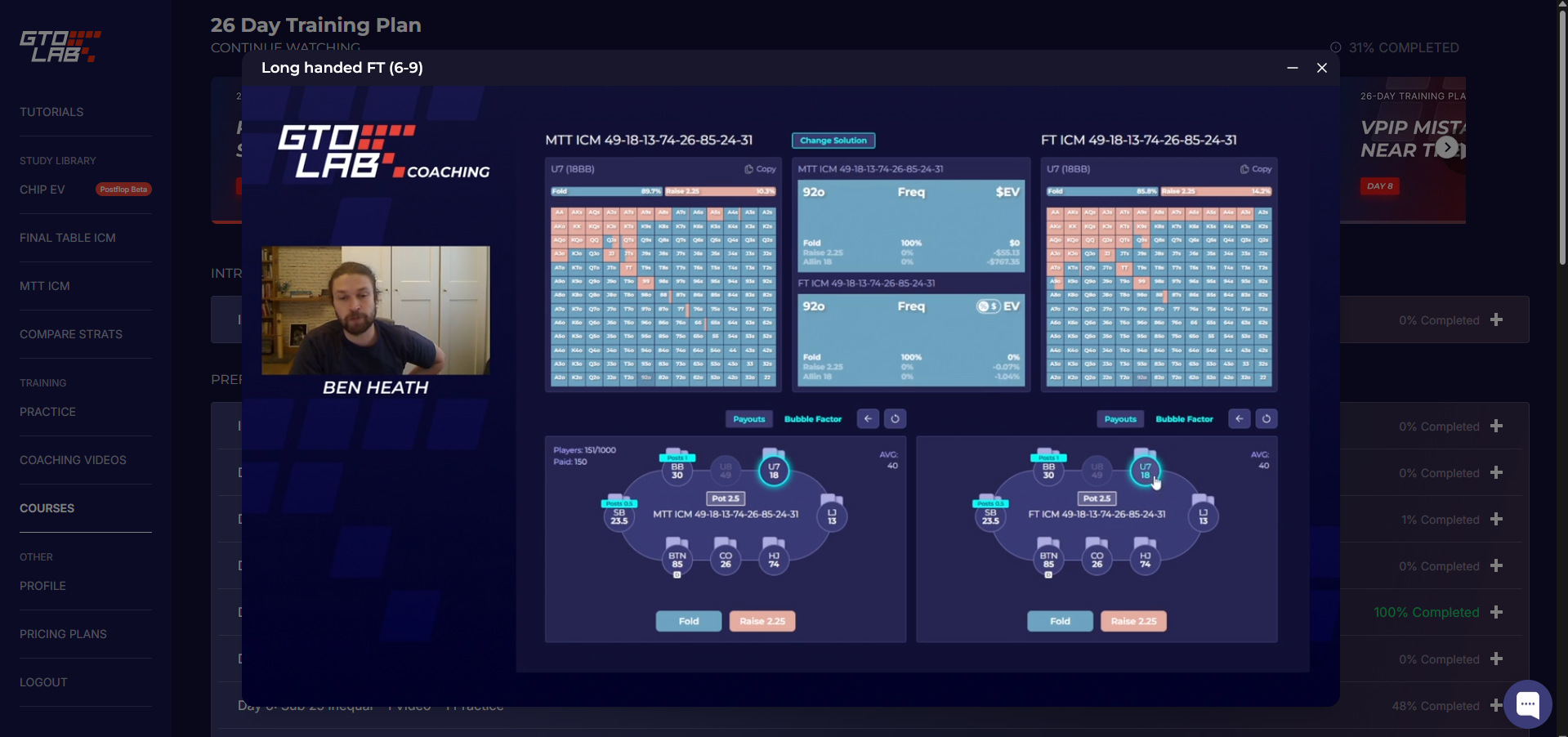
Nick Petrangelo reinforces this from the chip leader’s side: the chip leader’s opening range already contains a disproportionate amount of pressure hands — what he calls the pyramid of weak holdings at the bottom of the grid. That wide range is also exploitable. Being the chip leader isn’t just printing money; it comes with a wide range that opponents can attack.
Medium stacks: the most complex ICM vs chip EV environment
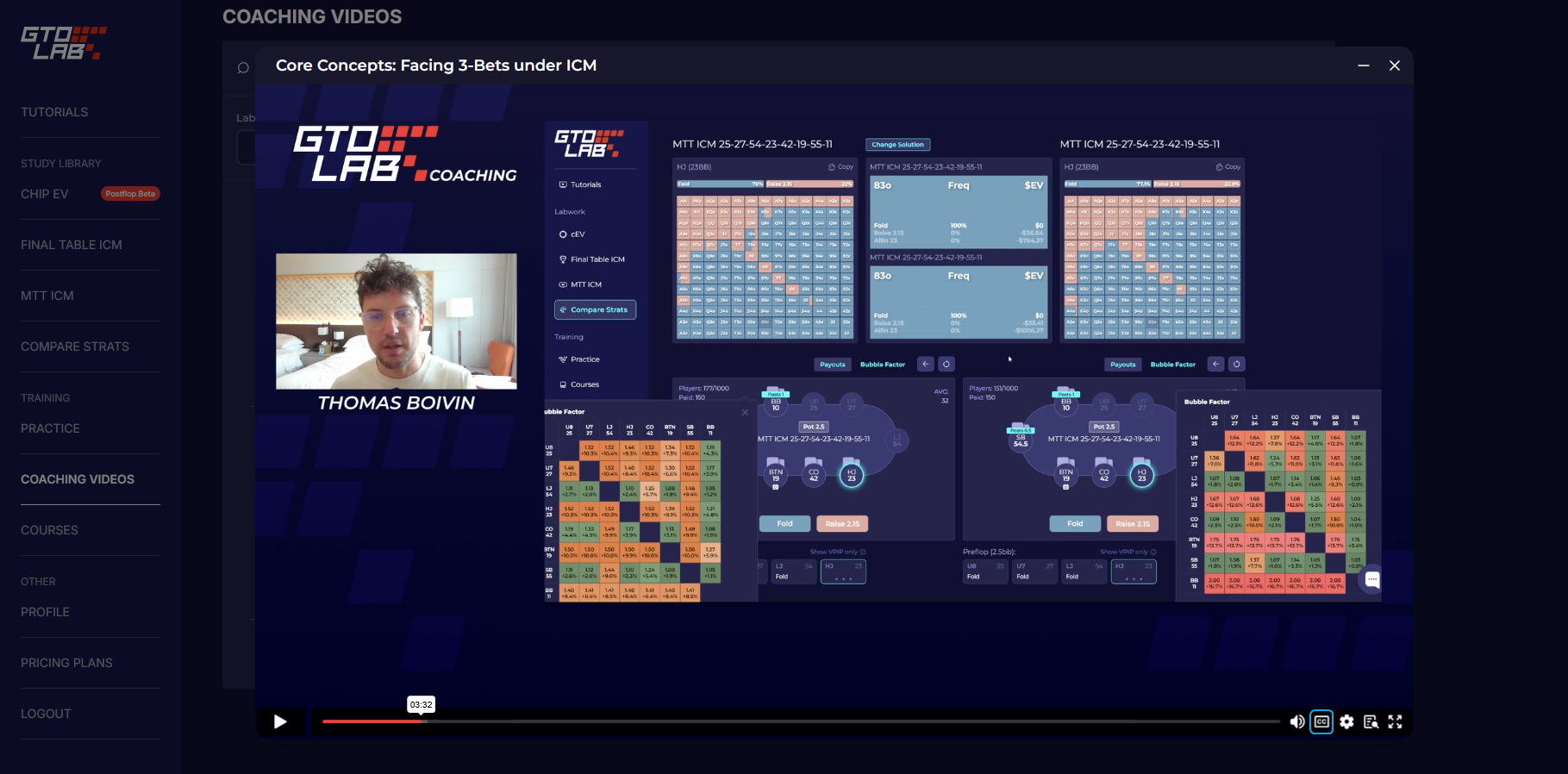
Thomas Boivin‘s work on facing 3-bets under ICM pressure reveals something non-obvious about medium stacks: the bigger the difference in risk premiums between two players, the wider the flatting range becomes — not narrower. When a medium stack’s risk premium against a big stack is significantly higher than the reverse, it actually opens up calling lines and postflop leverage that wouldn’t exist under chip EV.
Thomas’s analysis shows that near the stone bubble, medium stacks facing 3-bets flat considerably more often than before the bubble — 11% flat frequency versus 6% — precisely because the 3-bettor’s range is forced to be more polar and the medium stack can leverage the other player’s ICM constraint postflop. The common instinct to tighten everything uniformly under ICM pressure misses this entirely.
Axel Hallay adds another layer in his work on preflop bluff-to-value ratios under ICM: under chip EV, 3-bet bluff-to-value ratios in the BB run roughly 0.7–1 bluff per value combo. Under ICM, that ratio compresses — but the degree of compression depends on specific risk premiums, not a blanket rule. Medium stacks who apply a uniform tightening heuristic end up with 3-bet frequencies that are wrong by meaningful amounts depending on stack geometry.

Short stacks: the counterintuitive ICM vs chip EV freedom
Daniel Dvoress‘s analysis in Tournament Savagery surfaces an ICM vs chip EV result that catches many players off guard: short stacks in clear last place often have lower risk premiums than the medium stacks around them, making them freer to gamble. When you’re already at high risk of finishing last regardless, the marginal cost of getting eliminated in this hand is low. ICM has less to protect.
A medium stack sitting just above elimination — say, 3rd of 4 remaining players near a meaningful pay jump — can have bubble factors significantly higher than either the chip leader or the shortest stack. They’re the player most exposed to ICM pressure from both sides. ICM pressure peaks in the middle, not at the bottom of the stack distribution.
Where bubble factors break down
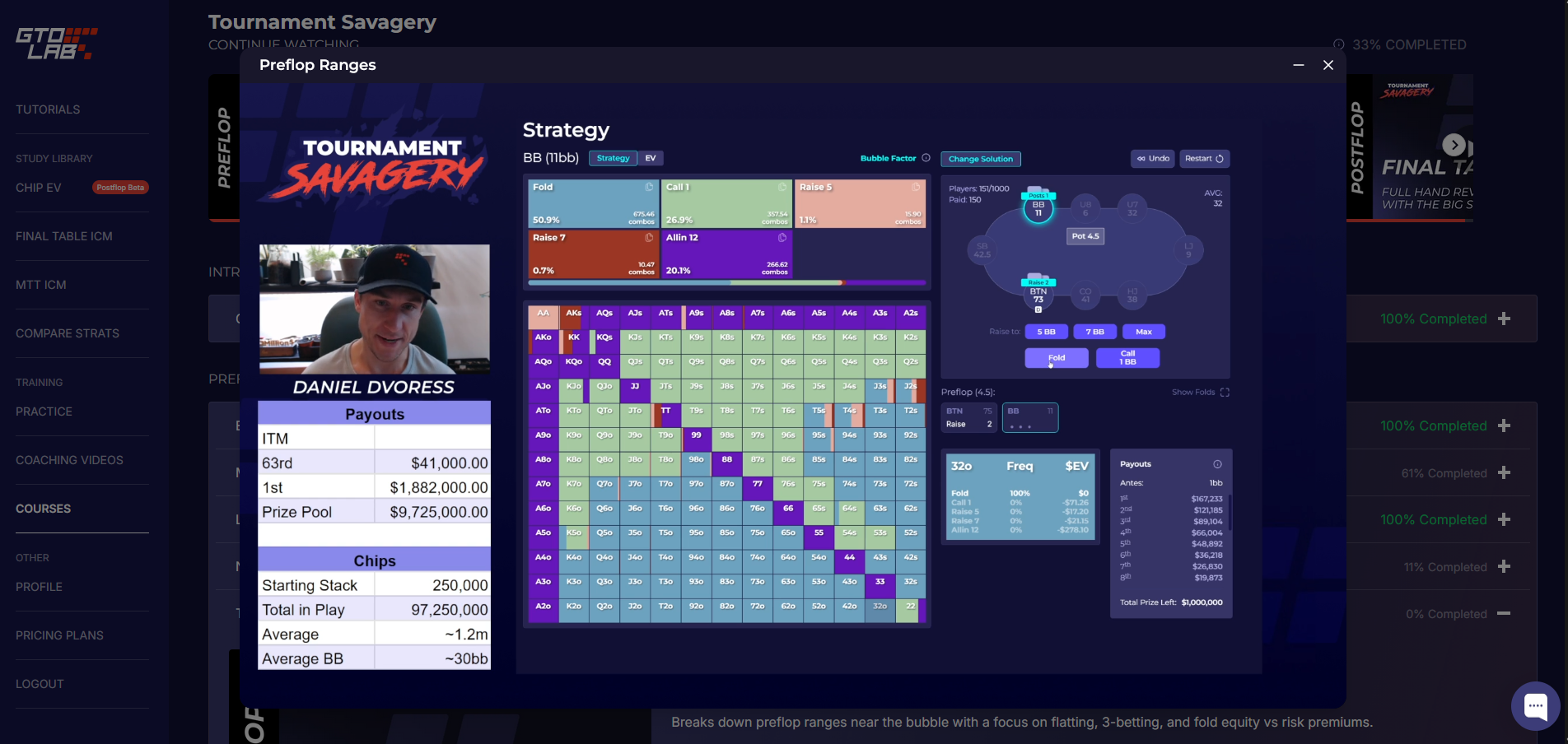
Daniel is explicit in Tournament Savagery that bubble factors are useful but limited. Two warnings stand out as particularly important for how most players misapply them.
First: bubble factors assume the tournament ends after the current hand. They don’t account for future orbits, exploitation opportunities, or the long-term value of a big stack. In spots where future game dynamics matter — a 150BB chip leader with hours of antes left — the bubble factor understates how aggressively they can play.
Second, and more important: bubble factors model an all-in confrontation specifically. They’re most accurate when your decision is binary — call or fold a shove, with the hand ending all-in or not. They become misleading in spots where all-in confrontations are not the likely outcome. Two deep stacks playing a 3-bet pot postflop: the bubble factor between them tells you very little about how to size your bets on the turn.
Key distinction
Bubble factors are a tool for all-in decisions. For postflop play — bet sizing, check-raising, bluffing frequencies — reason from range vs range under ICM, not from a bubble factor number. As Nick puts it: it’s still poker, it’s still range versus range. ICM adds a constraint on that range; it doesn’t replace the poker.
The practical study method
The fastest way to build genuine ICM vs chip EV intuition is to run the same hand through a solver under both modes — cEV first, then ICM — and document the differences hand by hand. PioSolver supports this directly. The divergences follow consistent patterns, and learning those patterns is what builds table-ready instinct.
Nick recommends approaching ICM vs chip EV study from two sides simultaneously: pattern recognition (running many similar spots to see thresholds) and mechanical fundamentals (understanding what the model is actually calculating). GTO LAB’s Tournament Savagery and 26-Day Training Plan are built around exactly this two-sided methodology.
Before each study session, label the environment — is this an ICM vs chip EV decision, and which side of that gap applies? If the solver output surprises you relative to your prediction, that gap is the learning. Players who skip the labeling step scroll through solutions without building the underlying ICM vs chip EV model — and the model is what actually transfers to the table.
Frequently asked questions
Does ICM apply in cash games?
No. Cash game chips always convert to dollars at a fixed rate. ICM only applies in tournaments where the prize structure creates asymmetry between chip percentage and actual dollar equity.
Can a bubble factor be below 1?
No. The core ICM asymmetry means the bubble factor is always above 1. In spots with minimal ICM pressure it approaches 1 (nearly chip EV), but never drops below it.
If I’m the chip leader, am I in a chip EV environment?
No — this is one of the most common ICM vs chip EV misconceptions. As Ben Heath explains, chip leaders at final tables still operate under significant ICM pressure in pots against other large stacks. Chip leadership reduces your risk premium against shorter stacks; it doesn’t eliminate ICM from your decisions.
When does chip EV thinking get players in trouble?
Most often in medium-stack call-off spots near pay jumps. The pot odds look right, the equity looks right — but ICM says the cost of busting outweighs the chip gain. Thomas Boivin’s analysis also shows chip EV thinking fails in 3-bet range construction near bubbles.
Do I need to calculate bubble factors at the table?
No. The goal is pattern recognition through study so you identify the approximate ICM pressure level of different stack configurations instinctively. You learn the math so you don’t need to compute it under pressure.
Key takeaways
- Chip EV is linear — ICM is asymmetric. Losing chips always costs more in dollar terms than winning the same chips gains. That gap is the risk premium.
- Bubble factors quantify the ICM vs chip EV gap. Always above 1. Calculated as EV lost ÷ EV gained. Typically 1.2–1.6 in real spots; extreme cases reach 2.0+.
- Big stacks still operate under ICM. Two large stacks building a big pot lose combined EV to the rest of the table. Cooperative sizing is often the correct play.
- Medium stacks face the most complex ICM vs chip EV environment. Asymmetric risk premiums create flatting and bluffing opportunities that uniform tightening misses.
- Short stacks in clear last can have lower risk premiums than medium stacks. ICM pressure peaks at the middle of the stack distribution, not the bottom.
- Bubble factors only apply to all-in decisions. For postflop play, reason from range vs range under ICM.
- Study both sides. Pattern recognition and mechanical understanding together build the intuition that transfers to the table.
ICM Strategy — Complete Guide
→ What Is ICM in Poker?
→ How to Study ICM Effectively (coming soon)
→ ICM at the Final Table (coming soon)
→ Postflop ICM Adjustments (coming soon)
→ ICM on the Bubble (coming soon)
→ How Solvers Calculate ICM (coming soon)
→ Common ICM Mistakes (coming soon)
→ How to Actually Improve at ICM (coming soon)
Train with GTO LAB: ICM Trainer · Tournament Savagery · 26-Day Training Plan