



Author: Daniel Dvoress
Context: Based on a GTO LAB coaching video
Concept Context
In many common tournament nodes like CO open vs BB defend at ~40bb, BB checks flop, a solver will often use multiple continuation bet sizes (for example ~25%, ~50%, ~80% pot). That creates an immediate practical question for players building a usable strategy:
If a solver mixes two medium-to-large sizes (say B50 and B80) on the same flop class, can you simplify by using one merged size (e.g., ~B60–B67) and keep most of the EV?
The useful answer is not “yes” or “no” globally. The key is how the range allocates those sizes across individual hands.
Technical Explanation
1) Don’t judge “size mixing” by the board-level percentages alone
A flop report might show something like:
- Range bets B50 a lot
- Range also bets B80 a meaningful amount
- Sometimes the split looks close (even ~50/50)
That board-level split can be misleading. The practical question isn’t only “does the range mix sizes?” It’s:
Do most hands use sizes in roughly the same proportions as the overall range?
If yes, merging sizes tends to be relatively safe. If no, merging sizes starts to blur intentional hand-class incentives.
2) The “mirrors global split” condition
On some boards, the solver’s overall strategy might be something like:
- Range: B50 73%, B80 27%
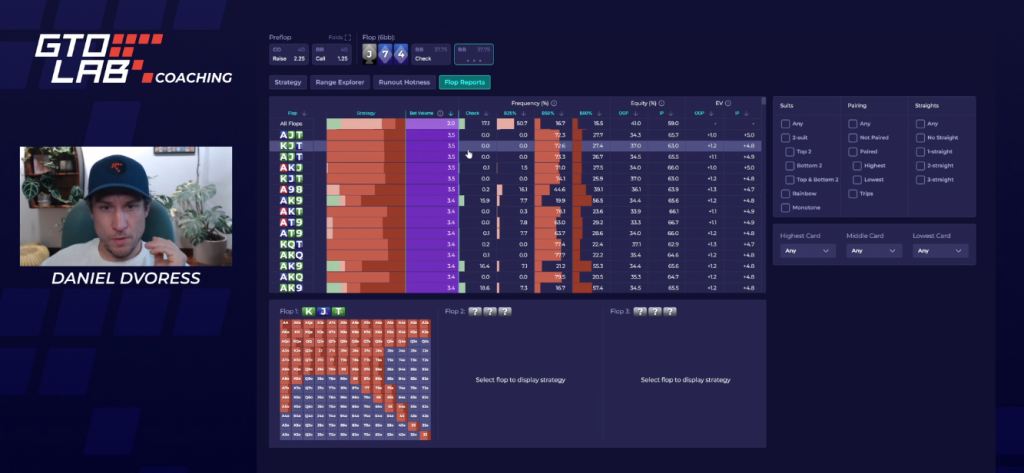
If you then look at individual hands and see that most combos follow that same 73/27 tendency, you’re in the “mirrors global split” scenario. A few hands may deviate (e.g., some value hands sizing down, some value hands sizing up), but deviations are limited and not central to the range.
In this case, a merged size (often slightly closer to the more-used size) can preserve much of the structure, because:
- You aren’t collapsing two distinct “hand buckets” into one size.
- You’re mostly collapsing a distributional preference that’s shared across the range.
Practically, that means you can pick a size like ~B60–B65 and expect that many hands that used either B50 or B80 are still reasonably represented by that single sizing.
3) When the range does not mirror itself
On other boards, the solver may again show something like:
- Range: roughly split between B50 and B80 overall
But then, when you inspect specific hands, you find clear hand-class separation:
- Strong Ax / two pair / sets disproportionately prefer the larger size relative to the range average.
- Weaker pairs / marginal made hands disproportionately prefer the smaller size relative to the range average.
This is the scenario where “every hand mixes both sizes” is a trap. Even if many combos technically mix, the direction of the deviation matters: the strategy is using sizing to express different goals for different parts of the range.
When you merge sizes here, you are no longer just simplifying a mixed strategy—you’re often removing a tool the strategy uses to:
- Extract value while charging draws with the top of range
- Keep weaker made hands from inflating pots or getting punished by check-raises / continues
- Maintain coherent incentives for BB’s continuing range
In other words, the solver isn’t mixing sizes because it’s indifferent. It’s mixing sizes because different hands want different outcomes.
4) Concrete contrast from flop reports
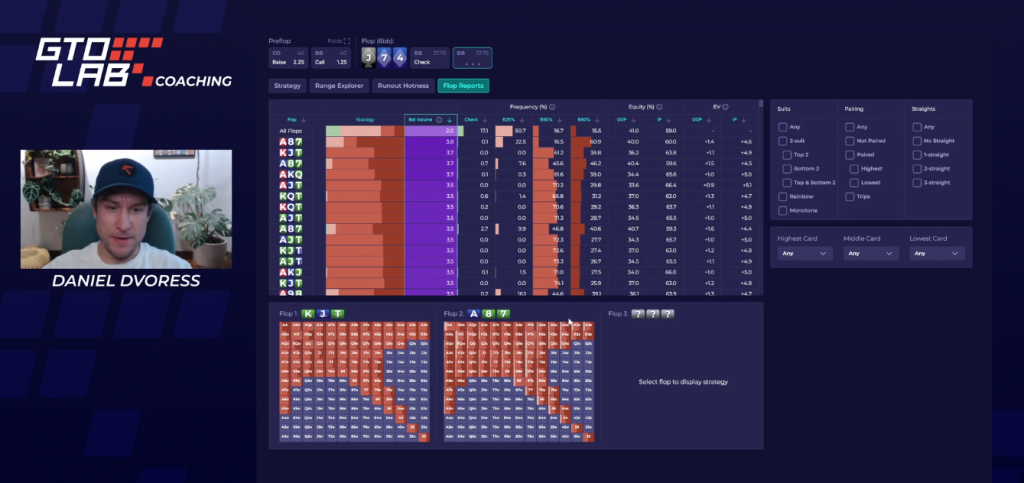
A helpful way to frame it is with two example textures from the node:
- Example A (merge-friendly): a board like KJT
The range may prefer a dominant size (e.g., B50) with some B80. Many hands allocate sizing roughly in line with the global split. There are exceptions (some very strong hands may size down; some strong-but-not-multi-street hands may size up), but there isn’t a widespread “this bucket wants big, that bucket wants small” separation. - Example B (merge-risky): a board like A87
The range might look ~50/50 overall, but individual hands diverge meaningfully: strong Ax and nuttier value push toward bigger, while weaker pairs and marginal hands pull toward smaller. That deviation pattern is the warning sign that merging sizes will distort how different hand classes realize EV.
Practical Implications
A workable simplification rule:
- If most hands’ size splits track the range split, you can usually merge two adjacent sizes into one middle size with limited EV loss.
- If many hands’ size splits systematically deviate (clear buckets preferring different sizes), merging is more costly.
How to apply this quickly in practice (without brute memorization):
- Start with the board’s overall sizing split (e.g., B50 vs B80).
- Check a few representative hand classes:
- Strong value (top pair good kicker, sets/two pair)
- Medium value (one-pair middling)
- Equity hands (straight draws, overcards + backdoors)
- Strong value (top pair good kicker, sets/two pair)
- Ask: Are these classes mostly matching the range-level split, or are they pulling in opposite directions?
If the answer is “opposite directions,” the sizes are doing different jobs—and a single merged size will force compromises.
Common Mistakes
- Mistake 1: Using the board’s B50/B80 split as the only signal.
A 50/50 board-level split can still be highly structured at the combo level. - Mistake 2: Assuming “everyone mixes” means indifference.
Mixed strategies can hide strong preferences in aggregate. The question is whether preferences are aligned across hands. - Mistake 3: Picking a merged size that’s too centered.
If the solver is 73/27, a “perfect middle” size can be worse than a size closer to the dominant action (often nearer the smaller of the two if that’s the bulk size). - Mistake 4: Overgeneralizing across textures.
Merge-friendly boards often share the property that sizing is mostly a global policy. Merge-risky boards often have clearer hand-class incentives tied to protection, vulnerability, and BB’s ability to continue with draws.
Short Summary
Merging two flop c-bet sizes is most reliable when individual hands “mirror” the range’s global size split, meaning the solver isn’t using sizing to sharply separate hand classes. When strong hands and weak hands systematically prefer different sizes, merging forces those classes into the same price point and usually gives up more EV. The practical test is simple: don’t just read the board-level split—spot-check whether key hand classes deviate in the same direction or in opposite directions.